
The Forgetting Curve, Explained
You walk out of a lecture feeling like you understood everything, and a week later most of it is gone. That is the forgetting curve at work. The Ebbinghaus forgetting curve is a model that describes how memory for new information fades over time when you make no effort to review it. The decline is not gradual and steady. It is steep at first, then slows down, which is the single most useful thing to know about it.
The good news is that this decay is predictable, so you can design a study system that works with your brain instead of against it. This guide explains where the curve comes from, gives you a simple timeline of how fast we forget, and shows how spaced repetition and active recall let you beat it.
Key Takeaways
- The forgetting curve, first plotted by Hermann Ebbinghaus in the 1880s, shows that memory of new material drops fast at first, then levels off.
- Most forgetting happens in the first hours and days, which is why timing your reviews matters more than total hours studied.
- The exact percentages vary by source and material. The reliable part is the shape, not any single number.
- Spaced repetition flattens the curve: each well-timed review lifts retention and makes the next decline slower.
- Active recall (testing yourself) strengthens memory far more than rereading. Combined with spacing, it is how you overcome the forgetting curve.
- Apps like Betta automate the timing, turning your notes into flashcards and scheduling each review for the right moment.
Who Was Hermann Ebbinghaus and What Did He Discover?
Hermann Ebbinghaus was a German psychologist and one of the first people to study memory experimentally rather than philosophically. In the 1880s, working alone, he memorized long lists of nonsense syllables, made-up combinations like "wid" or "zof" chosen precisely because they carried no meaning to bias the results.
He then tested himself at intervals ranging from 20 minutes to 31 days, measuring how many repetitions it took to relearn each list. From the savings in relearning he calculated how much he had retained and plotted it against time. The result was the first forgetting curve: a line that fell sharply soon after learning, then declined more and more slowly.
Modern researchers still debate the exact mathematical form of the curve, whether it is best described as exponential, a power function, or something else, but there is broad agreement on the headline finding. A 2015 study by Murre and Dros replicated Ebbinghaus closely and confirmed the same steep early drop. The shape is real even where the precise equation is not settled.
What Is the Forgetting Curve, Exactly?
The forgetting curve describes the decline of memory retention over time when there is no attempt to review or use the information. Plotted on a graph, the vertical axis is how much you still remember and the horizontal axis is time since learning. The line starts at 100 percent and falls, fast at first, then gently.
A useful idea behind the curve is the strength of a memory. The deeper or more often something is encoded, the flatter its curve. A fact you barely registered decays almost immediately, while one you understood deeply and connected to things you already knew sticks around far longer. A common illustrative equation is R = e^(-t/S), where R is retention, t is time, and S is a parameter for the strength of the memory. Treat that as a model that captures the shape, not a precise formula for your brain.
Several factors change how steep your personal curve is: whether the material is meaningful or arbitrary, whether you learned it by passively reading or by actively practicing, and your sleep, stress, and attention at the time. This is why two people can leave the same class and forget at very different rates.
A Simple Forgetting Curve Timeline (Without Review)
Here is a synthetic forgetting curve timeline, presented the way most summaries present it. One warning first: the exact percentages vary a lot between sources and depend heavily on the type of material. Focus on the pattern, a sharp early drop followed by a plateau, rather than on any single figure. The numbers below are pedagogical approximations, not measurements from your own memory.
Forgetting Curve Timeline
| Time since learning | Roughly how much you retain | What is happening |
|---|---|---|
| After a few minutes | Most of it, minus weak details | Fragile details slip first, especially if attention was low |
| After 20 to 60 minutes | Around 50 to 60 percent | Rapid early loss begins if nothing consolidates the memory |
| After 24 hours | Around 20 to 40 percent | The steepest part of the drop, the day that matters most for a first review |
| After 1 week | Around 15 to 25 percent | The curve starts to flatten for whatever survived |
| After 1 month | Around 20 percent or less | A small residue remains, still without any review |
You will see bolder claims elsewhere, like "we forget 90 percent within a week". Treat those as teaching simplifications rather than exact constants. The takeaway that actually matters is that most forgetting happens in the first hours and days, which has a direct implication: the first review should come quickly, not the night before an exam.
Why We Forget: The Science Behind the Curve
Forgetting is not simply a failure of the brain. It is partly an optimization. Your brain prunes information it does not appear to need so the things you do use stay accessible. The forgetting curve is what that pruning looks like when plotted over time.
It helps to separate familiarity from true recall. Recognizing something when you see it (familiarity) is easy and fades slowly. Producing it from memory without a cue (recall) is harder and is what the forgetting curve mostly tracks. This distinction is why rereading feels productive but does little, you are training familiarity, not recall.
There is also a counterintuitive principle here called desirable difficulty. A little forgetting between study sessions makes the next retrieval harder, and that effort is precisely what strengthens the memory. Reviewing while material is still fresh feels good but teaches your brain less than reviewing once it has started to fade.
Common Misconceptions About the Forgetting Curve
The biggest misconception is that the raw numbers apply to everything. Ebbinghaus tested nonsense syllables on a single subject, himself, under tightly controlled conditions. He never tested anatomy, law, or maths. Meaningful, well-connected material forgets more slowly than his syllables did, so the steep curve is a worst case for arbitrary information, not a universal rate.
The second misconception is that the curve is a fate you cannot escape. It only describes what happens without review or use. The moment you retrieve the information, the picture changes, which is the whole point of the rest of this guide.
And remember the third point from earlier: forgetting is not purely a defect. Clearing out noise and irrelevant detail is useful. The aim is not to remember everything forever, it is to keep what you have decided is worth keeping.
From the Forgetting Curve to the Spacing Effect
If the forgetting curve is the problem, the spacing effect is the first half of the solution. The spacing effect is the finding that repetitions spread out over time produce much better long-term retention than the same amount of study packed into one session. In other words, three short reviews on three different days beat one long cram.
This is one of the most reliable results in learning science. Meta-analyses, including work by Cepeda and colleagues, show the advantage of spaced practice over massed practice across different ages, subjects, and contexts. There is also a lag effect: there is an optimal gap between reviews. Too short and you gain little, too long and you forget too much before the next pass.
The practical conclusion is simple. You want to schedule each review for the moment just before the curve predicts your recall will fall too far. Get that timing right and every minute of study does more work. To see this applied to a deadline, our guide on spaced repetition for exam prep at /guides/spaced-repetition-exam-prep walks through a full plan.
Active Recall and the Testing Effect: The Other Half
Spacing handles when you review. Active recall handles how. Active recall, also called the testing effect, is the finding that trying to retrieve an answer from memory strengthens it far more than rereading or highlighting the same material. Every time you successfully pull something out of your head, you make it easier to pull out next time.
In a widely cited 2013 review, Dunlosky and colleagues ranked common study techniques by how well they work. Practice testing and distributed practice landed in the high-utility tier, while popular passive methods like rereading and highlighting landed low. The combination of spaced repetition and active recall beats sheer hours of rereading by a wide margin.
In practice this means closing the book and trying to say the main ideas out loud, or using flashcards with a question on one side and the answer on the other. Each card is a tiny test. If you want the deeper comparison, see active recall versus rereading and why testing wins.
How Spaced Repetition Flattens the Forgetting Curve
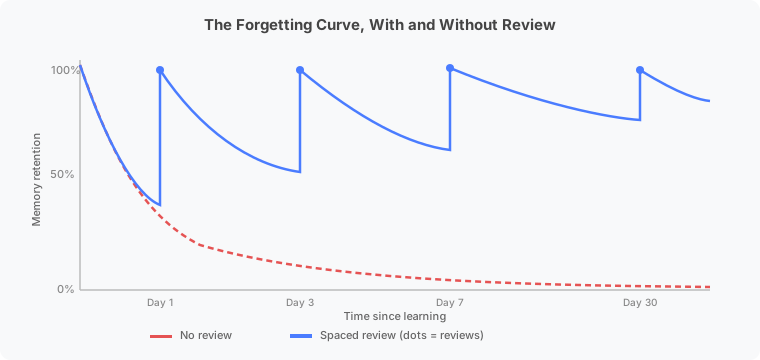
Picture the no-review curve from earlier, dropping steeply after you learn something. Now add a review at the point where your recall has started to fade. That review lifts retention back toward 100 percent, and crucially, the new curve that follows is flatter than the original. You forget more slowly than you did the first time.
Do it again at the next dip and retention climbs higher still, with an even gentler slope afterward. After each review the forgetting starts over, but more slowly, so the gaps between reviews can keep growing: a day, then a few days, then a week, then a month. That expanding schedule is the heart of spaced repetition.
This is exactly what flashcard systems model. The Leitner box method does it with physical boxes and fixed intervals, explained in our guide at /guides/leitner-system, while modern apps calculate a custom interval for every individual card based on how easily you recalled it.
A Practical Forgetting Curve Study Schedule
There is no single perfect schedule, but the research points to dependable starting points. The rule of thumb from Cepeda and colleagues is that the gap between reviews should be roughly 10 to 20 percent of how long you want to retain the material. Want to remember something for a year? Reviews spaced weeks apart make sense. Want it for next week? Reviews a day or two apart.
For an exam in a week, a workable pattern is: learn on day zero, review the next day, again three to four days later, then once more the day before. For long-term knowledge like a language or medical facts, expanding intervals work better: day 1, day 3 or 4, day 7, day 14, day 30, then roughly monthly. To turn this into exact dates you can use the forgetting curve calculator at /tools/forgetting-curve, the Leitner interval calculator at /tools/leitner-calculator, or the broader planner at /tools/spaced-repetition-calculator.
The catch with any fixed schedule is that not every card needs the same spacing. Some facts stick on the first try, others fight you for weeks. Adaptive apps solve this by stretching the interval on cards you find easy and shortening it on cards you keep missing, so you spend your time where the curve is steepest for you.
Example Schedules for Different Goals
| Goal | Suggested review pattern | Why |
|---|---|---|
| Exam in 1 week | Day 0 learn, day 1, day 4, day before | Short retention window means short gaps |
| Exam in 1 month | Day 1, day 3, day 7, day 14, then weekly | Expanding gaps as the material sticks |
| Language vocabulary | Day 1, day 3, day 7, day 14, day 30, monthly | Long-term retention with growing intervals |
| Professional or compliance training | Short quizzes spaced over the weeks after the session | Counters forgetting that follows one-off training |
How to Use Flashcards to Beat the Forgetting Curve
Flashcards are the most direct way to put both halves of the science to work at once. Each card is a small active-recall test, and the order in which cards come back to you is the spaced-repetition schedule. Together they target the steepest part of your forgetting curve.
The classic low-tech version is the Leitner system: cards you get right move to a box reviewed less often, cards you get wrong come back soon. A modern app automates the same logic, detecting the right moment to resurface a card, spreading out the ones you have mastered, and bringing failed cards back sooner. Turning your own notes and slides into question-and-answer cards is what plugs your real coursework into the model.
This is where Betta fits in. You photograph your notes, a textbook page, or a slide, and Betta turns them into a ready-to-review deck, then schedules each card with spaced repetition so reviews land at the right moment. You do not calculate intervals or track dates, the app keeps each card on its own curve. For more on building good cards, see how to make flashcards from your notes.
Limitations of the Forgetting Curve (And Why It Still Matters)
It is worth being honest about the model. The original experiments used one subject, artificial material, and very specific conditions. Later research shows the exact shape of the curve can shift between an exponential and a power function depending on the task, and that individual differences in motivation, sleep, stress, and prior expertise move the curve substantially.
None of that undermines the practical value. The pattern of rapid early forgetting followed by slower decline is robust, and it gives you a clear, evidence-backed reason to review early, review actively, and space those reviews out instead of cramming. A model does not need to be perfect to be useful, it needs to point you in the right direction, and this one does.
Turning the Forgetting Curve Into a Learning Advantage
The most useful reframe is to stop seeing the forgetting curve as an enemy and start seeing it as a map of how human memory actually works. Once you know recall drops fast and then levels off, you know exactly when your effort pays off most: review just before the dip, test yourself rather than reread, and let the intervals grow as the material sticks.
If you review at the right moments and in the right way, you can remember far more in less total time. Never let more than 24 hours pass before the first review, space the later ones out, always favor a quick test over passive rereading, and use a tool that handles the timing so you do not have to. That last step is what an app like Betta automates, which is the simplest way to apply everything in this guide.
FAQ: The Forgetting Curve
- What is the forgetting curve in simple terms?
- The forgetting curve is a model that describes how quickly you forget new information when you never review it. Memory of fresh material drops fast in the first hours and days, then the decline slows and levels off. It is a pattern, not an exact law, but it explains why a lecture that felt clear can feel half gone a day later.
- Who discovered the forgetting curve?
- Hermann Ebbinghaus, a German psychologist, in the 1880s. He memorized long lists of nonsense syllables like "wid" and "zof", then tested how much he could relearn at intervals from 20 minutes to 31 days. The curve he plotted from that data is why it is called the Ebbinghaus forgetting curve.
- Is the forgetting curve real?
- Yes. The basic shape, rapid early forgetting followed by a slower decline, has held up across more than a century of research, including a 2015 replication of Ebbinghaus by Murre and Dros. Researchers still debate the exact mathematical form, but the pattern itself is robust.
- How fast do we forget according to the forgetting curve?
- Estimates vary by source and by the type of material, so treat the numbers as orders of magnitude. A common summary is that without review you lose a large share within the first day and keep only roughly 20 to 40 percent, with the curve flattening after about a week. The point is the shape, fast early loss, not any single percentage.
- How do you beat or overcome the forgetting curve?
- Combine two evidence-based habits: spaced repetition (spreading reviews over increasing intervals) and active recall (testing yourself instead of rereading). Each well-timed review lifts retention back up and makes the next decline slower. Flashcards or a spaced repetition app are the simplest way to apply both.
- What is the relationship between the forgetting curve and spaced repetition?
- Spaced repetition is the practical answer to the forgetting curve. It schedules each review for the moment just before the curve predicts your recall will drop too far. Reviewing at that point lifts retention and flattens the next stretch of the curve, so the gaps between reviews can keep growing.
- How often should I review based on the forgetting curve?
- Use expanding intervals: a first review within 24 hours, then a few days later, then a week, then two weeks, then a month, and so on. Research by Cepeda and colleagues suggests the gap between reviews should be roughly 10 to 20 percent of how long you want to remember the material. Adaptive apps adjust these intervals for you per card.
- Does rereading notes help against the forgetting curve?
- Far less than most people expect. Rereading creates a feeling of familiarity that is easy to mistake for real recall. Meta-analyses of study techniques rank passive rereading low and rank practice testing and distributed practice high for long-term retention.
- Is forgetting always bad?
- No. Forgetting is partly a feature, not just a bug. Your brain prunes information it does not use to keep what matters accessible. The goal is not to remember everything, it is to keep the things you decide are worth keeping, which is exactly what a review schedule lets you choose.