
Daily Review Calculator: How Long Should Your Session Be?
This daily review calculator answers one question: how long should your session be? It is a text tool, not a widget. You feed it two numbers, the cards due today and how many seconds you spend per card, and it returns the minutes your session will take. Run it the other way and it tells you how many cards fit inside 10, 15, or 20 minutes. Most people land best with a short daily session in that 10 to 20 minute band, and this page shows you exactly where you fall and how to stay there.
Short, frequent sessions beat occasional marathons for long-term memory, so the goal is never to grind every card you own in one sitting. It is to clear what is actually due, at a pace you can repeat tomorrow. If you would rather not run any math, Betta estimates today’s review time for you and quietly regulates how many new cards it adds so your session stays in range.
Key Takeaways
- Session minutes = (cards due × seconds per card) ÷ 60. That single line is the whole calculator.
- Run it backwards to plan: cards that fit = (target minutes × 60) ÷ seconds per card.
- Rules of thumb: about 6 to 10 seconds per review card and 10 to 20 seconds per new card.
- Measure your own time per card with a 5-minute timed test rather than trusting a guess.
- Aim for a 10 to 20 minute daily session. Below that you may be coasting, above 30 to 40 you are overloading.
- To stay in range, adjust new cards down, not review effort. New cards are the dial you control.
Why Short Daily Sessions Beat Long Ones
The case for a short session is the same case behind spaced repetition itself. Memory holds better when reviews are spread across many days than when they are crammed into one long block, so fifteen daily minutes outperform a single two-hour weekend session for what you still remember weeks later. Splitting the work also keeps you inside your window of real focus, where your recall and your self-grading stay honest.
There is a second, quieter reason. A daily session you can finish is a session you keep doing. A session that swells to 45 minutes becomes the one you skip on a busy day, and a skipped day is where forgetting creeps in. The job of the daily review is to catch each card near the right point on its forgetting curve, not to finish a whole chapter at once. For the timing side of that, the forgetting curve calculator at /tools/forgetting-curve maps how fast retention drops once a review slips.
The Daily Review Calculator Formula
Here is the formula at the heart of this daily review calculator, in plain words:
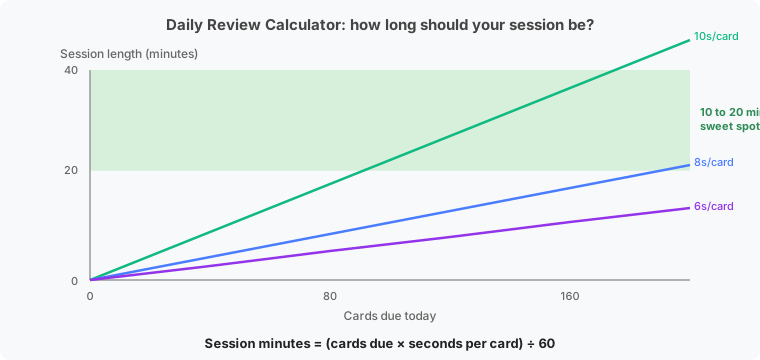
Session minutes = (cards due × seconds per card) ÷ 60
That is it. If you have 90 cards due and you average 8 seconds per card, your session is (90 × 8) ÷ 60 = 12 minutes. To plan around the time you have instead, flip the formula and solve for cards: cards that fit = (target minutes × 60) ÷ seconds per card. Fifteen minutes at 8 seconds per card is (15 × 60) ÷ 8 ≈ 112 cards. Decide which number you are missing, the time or the card count, and the formula hands you the other.
Time per card is the total for one card: reading the prompt, recalling the answer, flipping it, and grading yourself. As a starting assumption, use 6 to 10 seconds for a review card you have seen before and 10 to 20 seconds for a brand new card. These are rules of thumb, not lab numbers. The tighter and more atomic your cards, the closer you sit to the low end.
Separating New Cards from Reviews
A single average works for a quick estimate, but new cards genuinely take longer than reviews, so a more precise version splits them out:
Session minutes = (new cards × seconds per new card + review cards × seconds per review card) ÷ 60
Say you have 15 new cards at 15 seconds and 70 reviews at 8 seconds. That is (15 × 15 + 70 × 8) ÷ 60 = (225 + 560) ÷ 60 ≈ 13 minutes. Because reviews tend to outnumber new cards several times over, the new-card count is the lever that moves your total the most. Set your new cards from your target time, not the reverse. The exam study planner at /tools/exam-study-planner and the spaced repetition calculator at /tools/spaced-repetition-calculator both work from this same cards-versus-time idea over a whole study period.
Minutes Per Session for N Cards
| Cards due | At 6s per card | At 8s per card | At 10s per card |
|---|---|---|---|
| 40 cards | 4 min | 5 min | 7 min |
| 80 cards | 8 min | 11 min | 13 min |
| 120 cards | 12 min | 16 min | 20 min |
| 160 cards | 16 min | 21 min | 27 min |
| 200 cards | 20 min | 27 min | 33 min |
Scan down your card count and across your pace, and you can see at a glance whether you land inside the 10 to 20 minute band. Anything drifting into the high twenties or beyond is a signal to trim new cards or tighten your cards, not to push through.
How Many Cards Fit in 10, 15, or 20 Minutes
| Target session | At 6s per card | At 8s per card | At 10s per card |
|---|---|---|---|
| 10 minutes | ~100 cards | ~75 cards | ~60 cards |
| 15 minutes | ~150 cards | ~112 cards | ~90 cards |
| 20 minutes | ~200 cards | ~150 cards | ~120 cards |
Read this table the planning way. If 15 minutes is what you have and you review at 8 seconds a card, you can clear roughly 112 cards. If 60 of those are already due as reviews, that leaves room for only 10 to 15 new cards that day. The calculator quietly sets your new-card quota for you.
Light, Standard, and Heavy Session Profiles
| Profile | Daily time | New cards per day | Best for |
|---|---|---|---|
| Light | ~10 minutes | 0 to 10 new | Maintaining a vocabulary deck or a quiet week |
| Standard | 15 to 20 minutes | 10 to 20 new | Most students, most of the time |
| Heavy | 25 to 30+ minutes | 20+ new | Exam crunch or very large decks, watch for fatigue and backlog |
Why 10 to 20 Minutes Is the Sweet Spot
Ask how long should your session be and the daily review calculator keeps pointing at the same band: 10 to 20 minutes. The lower end is enough to maintain a moderate deck when you show up every day, and the upper end covers most students through normal coursework. The spacing effect rewards reviews that repeat across days, and a session this size is easy to repeat across days, which is the whole point.
Push much past 30 to 40 minutes of continuous review and the returns turn against you. Focus drifts, your self-grading gets sloppy, and the session starts feeling like a chore you dread, which is how routines die. A 10 to 20 minute block sits comfortably inside a focused window and pairs naturally with a Pomodoro: one review block, one break. For the habit framing around this, the guide at /guides/study-smarter-flashcards covers short daily sessions and the mistakes that bloat them.
Measure Your Own Time Per Card in 5 Minutes
Default numbers get you started, but your real pace is better. Here is a 5-minute protocol to measure it. First, pick a deck that is representative, not just your easiest cards. Second, set a timer for 5 minutes and review at your normal pace, no rushing. Third, count how many cards you got through. Fourth, divide: seconds per card = 300 ÷ cards reviewed. If you cleared 50 cards, that is 6 seconds per card. Fifth, drop that figure into the formula, and if you felt rushed, add a 10 to 20 percent buffer.
A few things skew the measurement, so watch for them. Cards that are too long or badly written inflate your time per card and are worth fixing rather than timing around. Notifications and multitasking make the number meaningless, so measure during real focus. And because new cards and reviews differ, you can run the test twice, once on each, if you want the precise split version of the formula.
Signs Your Session Is Too Short
- You finish in under 5 minutes and could easily add a small batch of new cards.
- Every card feels effortless, a hint your intervals are too short and you are reviewing too early.
- Your total cards learned barely moves week to week, so you are maintaining but not progressing.
- Fix it by adding a few new cards, or a second 10-minute micro-session, rather than jumping straight to 45 minutes.
Signs Your Session Is Too Long
- You regularly pass 30 to 40 minutes and feel like you are grinding cards rather than learning.
- You put off starting because the pile looks intimidating, which is friction that leads to skipped days.
- You finish drained, start scrolling mid-session, and your Again or Good grading gets careless.
- Fix it by capping the main session near 20 to 25 minutes, splitting the rest into a second short block, and cutting new cards back to 10 to 20 a day.
Staying in the 10 to 20 Minute Range
The reliable way to hold the range is to treat new cards as your control dial. Decide your time first, say 15 minutes, use the calculator to find how many cards that buys at your pace, subtract the reviews already due, and let the remainder be your new-card quota for the day. Reviews are non-negotiable once a card is due, so the new-card number is the one you actually get to set.
On heavy days, split rather than stretch. One 15 to 20 minute session is the standard. Two blocks of 10 to 15 minutes, morning and evening, carry a busy stretch better than a single long sitting. And when a backlog piles up, do not try to clear it all at once. Prioritise the most recent or most exam-relevant cards, spread the rest across a few days, and keep each session manageable. To turn all of this into a week-by-week plan, the flashcard study planner at /tools/flashcard-study-planner lays out a copyable schedule, and the guide at /guides/spaced-repetition-exam-prep shows how daily session length fits an exam timeline.
FAQ: Daily Review Calculator
- Is 10 minutes of spaced repetition enough?
- For a small or moderate deck reviewed every day, yes. Consistency matters more than raw minutes, so 10 daily minutes beats an hour once a week. During exam season or when you juggle several subjects you will usually need to push toward 15 to 20 minutes, or split the work into two short sessions.
- How long should I study flashcards per day?
- Most learners do best with 15 to 30 minutes of review per day, split into one or two short sessions. Aim for the 10 to 20 minute band first and only go longer when a deadline forces it. The priority is showing up daily, not maxing out a single long sitting.
- How long should my Anki session be?
- Long enough to clear the cards that are due, which for a well-tuned deck usually lands in 10 to 20 minutes. If your daily reviews regularly run past 30 to 40 minutes, you are adding too many new cards or your cards are too heavy. Lower the new-card count and the session shrinks back into range.
- How many new flashcards per day is sustainable?
- Around 10 to 20 new cards a day is sustainable for most people, because each new card generates several future reviews. A rough guide is that total daily reviews settle at roughly 7 to 10 times your new-card count. Pick the new-card number that keeps your session inside your target time, not the other way around.
- Does session length affect memory retention?
- The spacing between sessions and the act of active recall matter most. Session length matters indirectly: a session so long that you get tired degrades how carefully you recall and grade each card, which weakens the benefit. Short, focused sessions protect that quality.
- Can I combine the daily review calculator with Pomodoro?
- Yes. A 10 to 20 minute review block fits neatly inside a 25 minute Pomodoro, followed by a break. Treat flashcards as one focused mini-block in a larger study day rather than a marathon of their own.
- How do I estimate my own time per card?
- Run a 5-minute timed review on a representative deck, count the cards you got through, then divide 300 seconds by that count. That seconds-per-card figure goes straight into the formula. Betta can also estimate this for you from your real review behaviour rather than a guess.