
Leitner Box Calculator: Find Your Next Review Date
This Leitner box calculator is a text tool, not a widget. It gives you the interval table, the one-line formula, and worked examples so you can find your next flashcard review date by hand, on paper, or in a spreadsheet. The whole system rests on spaced repetition: review a card, and the better you know it, the longer you wait before the next review. The box a card sits in is what tells you that review interval.
If you want the background on where the boxes come from, read our guide to the Leitner system first. This page is the calculator: feed it a box number and a last review date, and it hands you the next one.
Key Takeaways
- The core formula is one line: Next review date = Last review date + interval(box).
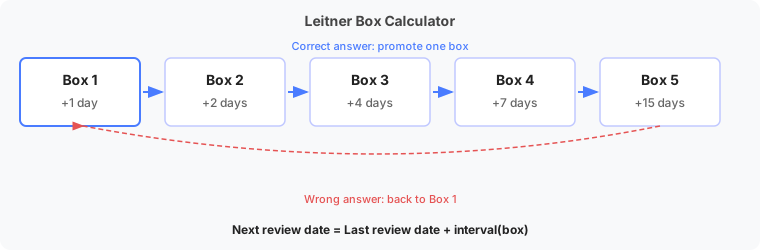
- The 5-box intervals are 1, 2, 4, 7, and 15 days for Box 1 through Box 5.
- A correct answer promotes the card one box. A wrong answer sends it back to Box 1 and the daily interval.
- A card that succeeds every time comes due at 1, 3, 7, 14, and 29 days after you first learn it.
- The exact dates matter less than the growing pattern. Review late rather than skip, and reset failed cards.
How the Leitner Box Calculator Works
Each Leitner box has a fixed review interval. To find when a card is next due, you only need two things: which box it is in, and the date you last reviewed it. The calculation is a single addition. The hard part, deciding the interval, is already done for you by the box.
Cards do not stay in one box. When you answer correctly, the card moves up a box and earns a longer interval. When you answer wrong, it drops back to Box 1 and returns to the daily pile. So the calculator runs every session: check the result, update the box, then add the new interval to today to schedule the next review.
The 1/2/4/7/15 Day Interval Table
| Leitner box (level) | Interval (days) | Typical mastery level | Example if last review was March 1 |
|---|---|---|---|
| Box 1 | 1 day | New or recently missed cards | March 2 |
| Box 2 | 2 days | Answered correctly once | March 3 |
| Box 3 | 4 days | Growing familiarity | March 5 |
| Box 4 | 7 days | Well-learned cards | March 8 |
| Box 5 | 15 days | Approaching full mastery | March 16 |
The Leitner Box Calculator Formula
Here is the formula at the heart of this Leitner box calculator, in plain words:
Next review date = Last review date + interval(current box)
The interval function is just the table above: interval(1) = 1 day, interval(2) = 2 days, interval(3) = 4 days, interval(4) = 7 days, interval(5) = 15 days. To apply it, follow four steps. First, identify which box the card is in based on its past successes and failures. Second, read the matching interval from the table. Third, add that many days to the last review date to get the next one. Fourth, write that date down in your planner or tracking sheet, or let an app handle it for you.
In a spreadsheet the same formula is one cell. If column B holds the box number and column C holds the last review date, the next review date is C + CHOOSE(B, 1, 2, 4, 7, 15). Filter your sheet to rows where the next review date is on or before today to see exactly which cards are due. For a study-period view of how many cards that means each day, the spaced repetition calculator and the daily review calculator both work from the same idea.
The Cumulative 1-3-7-14-29 Progression
The per-box intervals describe the gap to the next review. Counted from the day you first learn a card, the due dates of a card that succeeds every time add up differently. Each interval stacks on the last, giving a cumulative schedule of 1, 3, 7, 14, and 29 days after initial learning.
This matters because the cumulative pattern is what the spaced repetition research actually points to. It lines up closely with the widely cited 1-3-7-14-30 recommendation, which is why the 1/2/4/7/15 box intervals are a sound default rather than an arbitrary set of numbers.
Cumulative Schedule for a Card That Always Succeeds
| Review number | Box reviewed | Interval added | Days since first learning |
|---|---|---|---|
| 1st review | Box 1 | +1 day | Day 1 |
| 2nd review | Box 2 | +2 days | Day 3 |
| 3rd review | Box 3 | +4 days | Day 7 |
| 4th review | Box 4 | +7 days | Day 14 |
| 5th review | Box 5 | +15 days | Day 29 |
Worked Example 1: A New Card That Always Succeeds
You learn a new card on March 1. It starts in Box 1, so its first review is March 2 (March 1 + 1 day). You answer correctly, so it moves to Box 2.
From there each correct answer promotes it and stretches the gap. March 2 in Box 1, correct, becomes March 4 in Box 2 (+2). March 4 correct becomes March 8 in Box 3 (+4). March 8 correct becomes March 15 in Box 4 (+7). March 15 correct becomes March 30 in Box 5 (+15). After that the card stays in Box 5 and comes up every 15 days. Notice the due dates fall on the cumulative 1-3-7-14-29 day pattern measured from March 1.
Example 1 Timeline
| Review date | Box | Result | Next review date |
|---|---|---|---|
| March 1 | Box 1 (learned) | New card | March 2 |
| March 2 | Box 1 | Correct, promote to Box 2 | March 4 |
| March 4 | Box 2 | Correct, promote to Box 3 | March 8 |
| March 8 | Box 3 | Correct, promote to Box 4 | March 15 |
| March 15 | Box 4 | Correct, promote to Box 5 | March 30 |
| March 30 | Box 5 | Correct, stays in Box 5 | April 14 |
Worked Example 2: A Card Sitting in Box 3 Today
You last reviewed a card on June 10 and it is in Box 3. Box 3 has a 4-day interval, so: Next review date = June 10 + 4 days = June 14.
On June 14 you answer it correctly, so it is promoted to Box 4 with its 7-day interval. Its next review becomes June 21 (June 14 + 7). One addition per session, every time. The only thing that changes is the box, and with it the interval you add.
Worked Example 3: A Missed or Failed Card
The classic Leitner rule is that a failed card drops back to Box 1, the most frequent box, no matter how high it had climbed. This is the safety net: a card you suddenly cannot recall gets daily attention again until it sticks.
Say a card is in Box 4 and you review it on March 15 but get it wrong. It returns to Box 1, so its next review is March 16 (March 15 + 1 day). From there it has to climb the boxes again at the 1/2/4/7/15 rhythm. If a particular card keeps failing, that is the system working as intended: resetting it is better than leaving it stranded at a long interval you cannot honor.
Handling Weekends, Travel, and Off Days
Spaced repetition research is clear that a roughly increasing pattern of intervals matters far more than hitting an exact date. So when a review date lands on an impossible day, shift it by a day or two without guilt.
One simple rule helps: when in doubt, review a little early rather than late. Reviewing slightly ahead of schedule costs you almost nothing, while letting cards pile up past their date lets forgetting creep in. If you want to see how fast retention drops once a review slips, the forgetting curve calculator maps days since last review to a retention estimate.
Adapting the Calculator to Your Deadline
- Medium-term exam (weeks to months): the default 1/2/4/7/15 schedule is a strong general-purpose base.
- Near exam: compress the intervals, for example 1/2/3/5/10, so cards cycle faster before test day.
- Long-term learning (languages, medicine): add a Box 6 at 30 days after Box 5 to stretch mastered cards further.
- Whatever you change, keep the first review within 24 hours and make each interval longer than the last.
- Cap new cards at 10 to 20 a day so Box 1 stays manageable and daily reviews do not balloon.
Running the Calculator on Paper or in an App
On paper, number five dividers or boxes 1 through 5. Review Box 1 every single day without exception, then check which other boxes are due using the interval table. Pencil the next review date directly onto each card as you promote it, so the calculation is visible at a glance.
In a spreadsheet or Notion, use columns for Card, Box, Last Review Date, Interval, Next Review Date, and Result. The Next Review Date column is the formula from earlier, and each day you filter to cards due on or before today. It gives you total control at the cost of a little upkeep.
If you would rather not run the calculator at all, that is what Betta does. It stores each card level and computes the next review date with a spaced repetition schedule, so you just open the app and review what is due. You can even photograph handwritten notes or a textbook page and Betta turns them into a ready deck. To see how all this fits an exam timeline, read our guide on spaced repetition for exam prep.
FAQ: Leitner Box Calculator
- What is a Leitner box system?
- The Leitner system sorts flashcards into numbered boxes by how well you know them. New and missed cards sit in Box 1 and come up often. Each correct answer promotes a card to a higher box with a longer interval, so you spend most of your time on what you have not learned yet. It is a simple, paper-friendly way to apply spaced repetition.
- How does the Leitner box calculator work?
- You take the box a card is in, look up that box interval (1, 2, 4, 7, or 15 days), and add it to the last review date. Next review date = last review date + interval(box). That single addition is the whole calculation. The box level is what changes after each session, going up one box on a correct answer and back to Box 1 on a wrong one.
- Is the 1/2/4/7/15 schedule scientifically proven?
- Science backs the principle rather than these exact numbers. Research on the spacing effect shows that intervals should grow and that the first review should come within about 24 hours. The 1/2/4/7/15 pattern is a practical rule of thumb that fits the widely cited 1-3-7-14-30 cumulative timing, so it is a reasonable default to start with.
- What happens if I miss a review date?
- Do the review late rather than skip it. A day or two off schedule will not undo your progress. If a card is badly overdue or you fail it, send it back to Box 1 and let it climb again. The goal is a roughly increasing pattern of intervals, not hitting each date to the hour.
- How many new cards should I add per day?
- Most learners do well with 10 to 20 new cards a day. Because every new card lands in Box 1 and comes up daily, adding too many at once floods your daily pile and review time balloons. A steady intake kept up over weeks builds a strong deck without burning you out.
- Can I change the intervals to fit my schedule?
- Yes. Keep three rules and adjust the rest freely: the first review within 24 hours, intervals that keep growing, and a reset (or a step back) when you fail a card. For a near exam you might compress to 1/2/3/5/10. For long-term learning you can add a Box 6 at 30 days.
- Is there an app that runs this Leitner box calculator automatically?
- Yes. Betta applies a spaced repetition schedule for you, so you never track boxes or dates by hand. You photograph your notes, it turns them into flashcards, and it surfaces each card when it is due. The Leitner idea stays the same; the calculation is just invisible.