
Flashcard Study Planner: Build a 4-Week Schedule
This flashcard study planner gives you a complete 4-week study schedule you can copy: daily review targets, a day-by-day example table, and rules for how many new cards to add. It is built around spaced repetition, the finding that you remember more when reviews are spread out over time instead of crammed into one sitting. A meta-analysis of 254 studies covering more than 14,000 learners found that spacing reviews out improves retention by roughly 10 to 30 percent compared with massing them. Four weeks is enough time to feel that effect work.
The plan below is not a downloadable file. It is the template laid out in tables so you can rebuild it in a notebook, a spreadsheet, or your head. If you want the timing handled for you, Betta photographs your notes, turns them into flashcards, and schedules every review on its own, so this planner becomes the part you control while the app handles the rest.
Key Takeaways
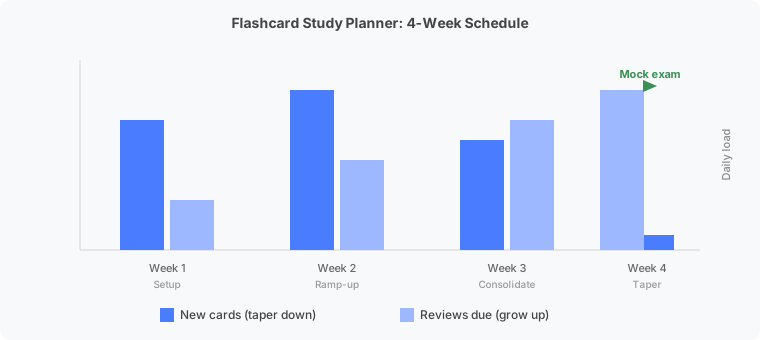
- A good 4-week study schedule ramps new cards up, then tapers them down so the final week is mostly review and mock exams.
- Do the reviews that are due first, every session, before adding any new cards.
- Cap your time, not your card count: 15 to 30 minutes a day, with 10 to 20 new cards as a typical ceiling.
- Reviews follow a growing 1-3-7-14-30 day interval pattern, so cards learned in week one get seen several times before the exam.
- Miss a day? Do the oldest due cards first the next day and add fewer new ones until the backlog clears.
Why Plan Flashcards Over 4 Weeks?
Most students make flashcards but never schedule them. They swing between cramming the night before and long gaps where they touch nothing, and both wreck retention. A flashcard study planner fixes the swing by turning study into a small, repeatable daily target you can actually hit.
Four weeks is the sweet spot. It is long enough for the spacing effect to compound, where each spaced review strengthens the memory more than a massed one would, and short enough to stay motivated and see the finish line. It maps neatly onto one chapter block, one exam run-up, or a 28-day habit reset. For the deeper science of timing your reviews, read our guide on the forgetting curve via the daily review calculator, and our guide to using spaced repetition for exam prep at /guides/spaced-repetition-exam-prep.
The 1-3-7-14-30 Interval Logic Behind the Schedule
Every review date in this planner comes from a single idea: review a card, and the better you know it, the longer you wait before seeing it again. A simple, widely used version is the 1-3-7-14-30 pattern. You review a new card one day after learning it, then three days later, then seven, then fourteen, then around thirty days out.
Counted from the day you first learn a card, those reviews land on day 1, day 4, day 11, day 25, and day 55. Within a 28-day plan, a card learned early gets four reviews before the month is out. The point is not to hit those dates to the hour. It is to keep intervals growing while reviewing every day. If you want to compute exact dates per card, the Leitner box version at /tools/leitner-calculator and the broader /tools/spaced-repetition-calculator both run from the same logic.
Daily Review Targets: Three Rules to Encode
Before the week-by-week plan, lock in the three rules that make any daily target work. They apply to every day of the 4-week study schedule.
Rule one: do the due reviews first. Open each session with the cards that are scheduled, and only then add new ones. The spaced repetition algorithm only helps if you actually clear what it surfaces. Rule two: cap your time, not your performance. Pick a ceiling like 20 or 30 minutes and shrink the number of new cards to fit it, rather than chasing a big day. Short daily sessions beat one long weekly block. Rule three: cut new cards on busy days. Too many new cards build a review backlog you start avoiding, so on a heavy day drop new cards to zero and just clear the due pile.
The 4-Week Study Schedule at a Glance
| Week | Goal | New cards per day | Review load | Daily time |
|---|---|---|---|---|
| Week 1 | Setup and gentle start | 5 to 10 | Light, first reviews kick in | 15 to 20 min |
| Week 2 | Controlled ramp-up | 10 to 20 | Growing as week-1 cards return | 20 to 30 min |
| Week 3 | Consolidation and interleaving | 10 to 15 | Heavy, longer intervals stack | 25 to 30 min |
| Week 4 | Mock exams and taper | 0 to 5 | Mostly review, exam-style practice | 20 to 30 min |
Week 1: Setup and a Gentle Start
Week one is about building the habit, not the deck. Spend days one and two making cards from your notes or textbook and keep the new-card count low so sessions stay short. Write atomic cards, one fact each, phrased as a question that forces real recall rather than a definition you can recognize on sight.
From day three, your first reviews start coming due at the one-day and three-day marks while you keep adding a small trickle of new cards. Keep it easy on purpose. If week one feels heavy, you will quit before the spacing effect ever pays off. If you would rather skip the card-making entirely, our guide at /guides/study-smarter-flashcards covers the formatting rules, and Betta can generate the cards straight from a photo of your notes.
Week 2: Controlled Ramp-Up
Now stabilize the routine and push new cards toward the 10 to 20 range, but let the actual review time decide. If clearing the due pile already takes more than 30 to 45 minutes, add fewer new cards, not more. The reviews from week one are now stacking on top of fresh material, so this is where time management matters most.
Week two is also when missed days first tempt you. If you skip one, do not binge-catch-up. Do the oldest due cards first the next day, hold your time cap, and add fewer new cards until the backlog drains. Add a quick note to yourself at the end of the week: should next week have more or fewer new cards? Adjust the target before week three rather than mid-session.
Week 3: Consolidation at Longer Intervals
By week three the cards you learned early are coming back at longer intervals, around the 7 and 14 day marks, which is exactly what consolidation looks like. New-card intake eases slightly so reviews have room. This is the week to start mixing topics in a single session, called interleaving, which sharpens your ability to tell similar concepts apart.
Start folding in exam-style practice too, not just plain recall. Throw in problems, multiple-choice questions, or short written answers that match how your test is actually formatted. Flashcards build the recall; exam-style practice proves it transfers. Note which chapters you have interleaved so you can spot anything you have been quietly avoiding.
Week 4: Mock Exams and Taper
The final week is for proving and polishing, not learning new material. Cut new cards sharply, ideally to zero by midweek, so all your time goes to long-interval reviews and full practice runs. Schedule one or two mock exam sessions where you work under conditions close to the real thing: timed, no notes, mixed topics.
After each mock, write down what still feels shaky and aim your last reviews there. The cards you keep failing are the ones worth your remaining attention. For a fuller exam-day plan and how to count cards against your deadline, the /tools/exam-study-planner works out daily targets for any number of days left.
Example Day-by-Day Schedule (One Standard Week)
| Day | New cards | Reviews | Est. time | Focus |
|---|---|---|---|---|
| Monday | 10 to 20 | All due cards first | 20 to 30 min | Core topic of the week |
| Tuesday | 10 to 20 | All due cards first | 20 to 30 min | Continue core topic |
| Wednesday | 10 to 15 | All due cards first | 20 to 30 min | Second topic |
| Thursday | 10 to 15 | All due cards first | 20 to 30 min | Second topic |
| Friday | 5 to 10 | All due cards, then exam-style practice | 25 to 30 min | Practice testing |
| Saturday | 0 to 5 | All due cards, or catch-up if behind | 15 to 20 min | Lighter or recovery day |
| Sunday | 0 | Light review only | 10 to 15 min | Weekly reflection and reset |
Reading the Example Schedule
Notice the shape of the week. Monday through Thursday are standard days: clear the due reviews, then add new cards to fill your time cap. Friday adds a dose of exam-style practice on top. Saturday is deliberately light, your built-in slack for catching up if a weekday slipped. Sunday is reflection: a short review and a quick check on whether to dial new cards up or down next week.
The columns are the template. Reviews always come first and always means all the due cards, not a fixed number. New cards carry a ceiling, not a quota, so on a heavy day you drop them without guilt. Estimated time is the real governor: if a day routinely overshoots, lower the new-card ceiling rather than skipping reviews.
Planner Variations by Student Profile
| Profile | New cards per day | Daily time | What to emphasize |
|---|---|---|---|
| High school | 10 to 15 | 15 to 20 min | Two or three subjects, short steady sessions |
| College / university | 15 to 20 | 25 to 30 min | Concept-plus-application cards, more practice testing |
| Language learner | 15 to 20 | 20 to 30 min | Vocabulary with example sentences, review words at 1-3-7-14-30 days |
| Medical / law (high volume) | 10 to 20 | 30+ min | Gradual deck loading, strict no-backlog discipline, long intervals for mastered cards |
Adjusting the Planner to Your Profile
The structure stays the same across profiles; only the dials move. A high school student juggling two or three subjects is better off with short 15 to 20 minute sessions and a lower new-card ceiling, while a college student can carry more volume and should weight the plan toward concept-and-application cards and practice testing.
Language learners get the most out of cards that pair a word with an example sentence and a use in context, reviewed on the 1-3-7-14-30 rhythm. High-volume learners in medicine or law live or die by backlog discipline: load decks gradually, protect long intervals for cards you already know, and never let the due pile snowball. Whatever the profile, keep the three daily rules intact.
Common Mistakes to Avoid
- Adding too many new cards per day, which floods your reviews and pushes you to abandon the plan.
- Skipping several days then trying to clear the whole backlog in one marathon session.
- Using the planner as a passive checklist: flipping cards and reading instead of genuinely recalling first.
- Treating the intervals as rigid: an approximate plan you keep beats a perfect one you drop.
- Setting unrealistic targets like three hours a day that collapse within the first week.
Running the 4-Week Planner With Betta
The planner decides the shape of your study; an app can decide the timing. With Betta the daily loop is simple: photograph your notes or textbook page, let Betta turn them into flashcards, and open the app each day to clear the cards it marks as due. You set how much time and how many new cards per the schedule above, and Betta picks which cards to surface using spaced repetition.
That split is the whole idea. The planner is the layer above the algorithm: it governs when you study, for how long, and on which subjects. Betta is the layer underneath: it governs which specific cards you see today so you never track boxes or dates by hand. Tick off your daily target, note anything shaky, and let the schedule carry you to exam day.
FAQ: Flashcard Study Planner
- How many flashcards should I do per day?
- For most learners, 10 to 20 new cards a day plus all the reviews that are due works well. Think in time before number: pick a daily cap of 15 to 30 minutes, do the due reviews first, then add as many new cards as the remaining time allows. A steady daily intake beats a big batch you cannot keep up with later.
- Is a 4-week flashcard schedule enough to prepare for an exam?
- Four weeks is a solid minimum because it gives spaced repetition room to work. It covers the 1-3-7-14-30 interval pattern almost end to end, so cards you learn in week one get reviewed several times before test day. If your exam is further out, keep the same structure and extend the reviews past 30 days.
- Should I only use flashcards and skip other study methods?
- Flashcards are strong for active recall, but they are not the whole picture. Pair them with practice problems, past papers, and writing answers from memory. The planner leaves room for exam-style practice in weeks three and four so your recall transfers to the format your test actually uses.
- What if I miss a day in my flashcard schedule?
- Do not try to clear the whole backlog in one marathon session. Come back the next day, do the oldest due cards first, and keep your normal time cap. Add fewer new cards until the pile is back to normal. A missed day costs you very little. Quitting because the backlog feels huge costs you everything.
- Do I have to follow exact spaced repetition intervals?
- No. The 1-3-7-14-30 day pattern is a guide, not a rule. What matters is that intervals keep growing and that you review regularly. Reviewing a day early or a day late changes almost nothing. An approximate plan you actually keep beats a perfect one you abandon.
- Can an app build this 4-week study schedule for me?
- Yes. Betta turns your photographed notes into flashcards and schedules each review automatically with spaced repetition. You set the shape of your week, how much time and how many new cards, and Betta decides which cards are due each day. The planner is the layer above the algorithm; Betta runs the algorithm underneath.