
Exam Study Planner: Cards Per Day Before Your Test
An exam study planner answers one question: you have a pile of flashcards and a fixed number of days, so how many cards per day do you actually need to study? This page is the planner. It gives you the calculation, a headline worked example of 200 cards in 14 days, four more scenarios, and the realistic limits that stop a plan looking great on paper and falling apart by day three. No widget to fill in, just the method and the numbers so you can build your own plan in a minute.
The trick is not dividing total cards by total days. That ignores reviews, rest, and the days life gets in the way. A good plan reserves buffer days, front-loads new cards early, and lets spaced repetition bring each card back two or three times before test day.
Key Takeaways
- Study days = days until exam minus buffer days. Keep 20 to 30 percent of your days as buffer.
- Cards per day = total cards divided by study days, then capped by the time you genuinely have.
- 200 cards in 14 days with 3 buffer days works out to about 18 new cards a day, well inside sustainable limits.
- Each new card creates roughly 7 to 10 reviews later, so 20 new cards a day peaks near 150 to 200 reviews a day.
- Front-load new cards in the first half, taper them off near the exam, and spend the last days on reviews and weak cards.
- If the plan demands more than 300 to 400 reviews a day, it is too aggressive: cut cards or start earlier.
How the Cards Per Day Calculation Works
The exam study planner runs in five short steps. Step one: count your study days. Start from the days until your exam and subtract the days you already know are blocked or that you want to keep as buffer for catch-up and rest. Step two: keep that buffer deliberately, around 20 to 30 percent of your days, so a missed day does not break the plan. Step three: divide your total cards by the remaining study days to get a baseline cards per day. Step four: cap that number by the time you actually have, since at 10 to 20 seconds per card a 30 minute session realistically covers new cards plus their reviews, not hundreds of brand-new cards. Step five: adjust for what you already know, because if half the deck is familiar your true count of new cards is much lower.
Written as a formula: study days = days until exam minus buffer days, then cards per day = total cards divided by study days. The cap matters as much as the division. A plan that says 60 new cards a day but only gives you 20 minutes is fiction. For a study-period view of how the daily load builds once reviews stack up, the /tools/daily-review-calculator works from the same logic, and the /tools/spaced-repetition-calculator shows how intervals stretch as cards stick.
Worked Example: 200 Cards in 14 Days
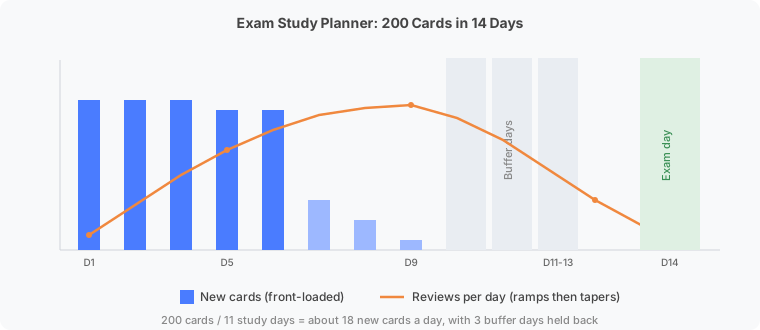
This is the headline case. You have 200 flashcards, your exam is 14 days away, and you can give it about an hour a day. Your goal is to see every card at least three times in active recall before the test. Start with the buffer: reserve 3 days, roughly 20 percent, for catch-up and the day before the exam. That leaves 11 study days.
The raw maths: 200 cards divided by 11 study days is about 18 new cards a day. That sits squarely inside the 10 to 20 new cards a day that the flashcard community treats as sustainable, so this plan is realistic rather than wishful. The work is front-loaded. You introduce most new cards in the first stretch, then the back half is dominated by reviews that spaced repetition surfaces on a 1, 3, 7 day rhythm.
Here is how it falls across the two weeks. Days 1 to 5 are the new-card push: around 20 to 25 new cards each day, plus the reviews of everything you learned on previous days. Days 6 to 10 flip the balance: few or no new cards, and your time goes to the growing review pile, giving most cards their second and third pass. Days 11 to 13 are buffer and light review, focused on the cards you keep marking as hard. Day 14 is a final skim, not new learning.
200 Cards in 14 Days: Day by Day Plan
| Days | New cards per day | Reviews per day (approx) | Focus |
|---|---|---|---|
| Days 1 to 5 | 20 to 25 | 20 to 90 and rising | Introduce most of the deck, first recall pass |
| Days 6 to 10 | 0 to 10 | 90 to 150 | Second and third passes, clear the review backlog |
| Days 11 to 13 | 0 | 60 to 120 | Buffer and catch-up, focus on hard cards |
| Day 14 | 0 | Light skim | Final review of weak cards only, no new learning |
More Cards Per Day Scenarios
The same method scales up and down. For each case below, study days is the days until the exam minus a buffer of roughly 20 to 30 percent, and cards per day is the total divided by those study days. The right-hand notes flag when a plan is comfortable, tight, or genuinely too aggressive to sustain.
50 cards in 7 days is a light plan: 1 buffer day leaves 6 study days and about 8 to 9 new cards a day, easy to finish in 15 to 20 minutes. 300 cards in 10 days is tight: 2 buffer days leave 8 study days and around 38 new cards a day, which pushes review counts high enough that you should consider trimming the deck. 500 cards in 30 days is roomy: about 6 buffer days leave 24 study days and roughly 21 new cards a day, with space for a full 1, 3, 7, 14 day spacing pattern. A 1000-plus card board-style deck over 60 to 90 days needs an early start above all, because the long window is exactly what makes spaced repetition pay off.
Scenario Table: Inputs to Cards Per Day
| Total cards | Days to exam | Buffer days | Study days | New cards per day | Verdict |
|---|---|---|---|---|---|
| 50 | 7 | 1 | 6 | 8 to 9 | Comfortable, 15 to 20 min a day |
| 200 | 14 | 3 | 11 | 18 | Balanced, the sweet spot |
| 300 | 10 | 2 | 8 | 38 | Tight, trim the deck if you can |
| 500 | 30 | 6 | 24 | 21 | Comfortable, full spacing fits |
| 1000 | 90 | 20 | 70 | 14 to 15 | Sustainable only if you start early |
What Cards Per Day Is Realistic
The division gives you new cards. The hidden cost is reviews. In any spaced repetition system, each new card you add comes back several times over the following days, and the flashcard community rule of thumb is that reviews run about 7 to 10 times your new-card rate once a deck is rolling. So 20 new cards a day does not mean 20 cards of work, it means 20 new plus 150 to 200 reviews at peak. That is why the planner caps new cards rather than letting the raw division run wild.
Power users do push to 250 or 350 cards a day during exam season, but that is several hours daily and not sustainable for most students alongside everything else. A safer ceiling: if your plan demands more than 300 to 400 reviews a day, treat it as a warning sign. The fix is one of two levers. Add days by starting earlier, or cut cards by keeping only the high-yield ones, the formulas, definitions and frequently tested facts, and dropping the nice-to-have rest.
When a Plan Is Too Aggressive
- More than 300 to 400 reviews a day for a part-time student is the red line, not a target.
- If new cards per day climbs above 30 to 40, the review pile behind it will overwhelm you within a week.
- Adding new cards in the final third of your timeline rarely pays off, since they get only one recall pass.
- When the numbers do not fit, add days or cut cards. Do not pretend you will study four hours a day.
- Prioritise: keep the high-yield cards every exam rewards, drop the optional ones first when time is short.
Buffer Days and Catching Up
Buffer days are the difference between a plan that survives contact with real life and one that collapses the first time you skip a session. Keeping 20 to 30 percent of your days free is not slack, it is insurance against fatigue, other deadlines, and the days you simply will not feel like studying. A 14 day plan with 3 buffer days assumes you will miss a few days, and still gets you there.
When you do fall behind, do not panic and do not abandon the plan. The recovery move is to pause new cards for a day or two and pour that time into the overdue reviews instead, because a card reviewed late still counts while a new card on top of a backlog just makes things worse. If you miss several days, recalculate from the new date and your current backlog, the same five steps with fewer days left. This is exactly the kind of recalculation Betta does for you automatically: miss a day and the daily target quietly adjusts so the plan still lands on exam day.
How the Planner Uses Spaced Repetition
A real plan does not show each card once. It schedules each card to come back at growing intervals, which is what makes the reviews pile up in the first place and what makes the learning stick. A Leitner-style approach captures this simply: cards you know move into slower piles, cards you miss drop back to the daily one, so your time concentrates on what you have not learned yet. The /tools/leitner-calculator shows how to work out each card next review date by hand.
For a near-term exam the intervals compress. Rather than the classic 1, 3, 7, 14, 30 day spacing meant for long-term memory, a two-week plan leans on a 1, 3, 7 day rhythm so each card still gets three passes before test day. The /guides/spaced-repetition-exam-prep guide walks through fitting spaced repetition to a deadline, and /guides/study-smarter-flashcards covers writing cards that are short enough to actually hit your daily target. If you would rather not track any of this by hand, Betta distributes your cards through a Leitner-like schedule and recalculates the plan as you go, so you open the app and review what is due.
Building Your Own Plan in Five Minutes
Run the five steps once and you have a plan. Count your study days after pulling out a buffer. Divide your total cards by those study days. Sanity-check the result against your real daily time and cap it if needed. Front-load new cards into the first half, taper them off, and reserve the last days for reviews and weak cards. The /tools/flashcard-study-planner walks through the same build with a worked weekly layout if you want a longer template.
Then start today rather than tomorrow, because every extra day of spacing makes each card stronger. If the maths refuses to fit your available time, that is useful information, not a failure: it tells you to either start earlier next time or to be ruthless about which cards earn a place in the deck. A smaller deck you actually finish three times beats a huge one you see once.
FAQ: Exam Study Planner and Cards Per Day
- How many flashcards should I study per day before an exam?
- Take your total cards, subtract a few buffer days from the days you have left, then divide. For 200 cards in 14 days with 3 buffer days, that is 200 divided by 11, or about 18 new cards per day. Cap that number by the time you actually have: at roughly 10 to 15 seconds per card, 20 new cards plus their reviews fits comfortably in 30 to 45 minutes a day.
- Is 200 flashcards a day too many?
- For most people, yes. The Anki community generally treats 10 to 20 new cards a day as sustainable, because each new card generates roughly 7 to 10 reviews over the following days. Twenty new cards a day already means 150 to 200 reviews a day at peak. Two hundred new cards a day is several hours of study and only realistic for full-time exam crammers.
- How many days do I need to memorize 200 flashcards?
- At a comfortable 15 to 20 new cards a day you need about 10 to 14 days to introduce 200 cards, plus time for the reviews that follow. Seven days is doable but intense at roughly 30 new cards a day. Thirty days is the relaxed version and gives spaced repetition the room it works best in.
- Is two weeks enough to use spaced repetition?
- Yes. Two weeks lets each card come back three to four times on a 1, 3, 7 day rhythm before the exam, which is enough spacing to beat cramming. You will not reach long-term mastery, but you will hold the material reliably through test day. The earlier you start, the more passes each card gets.
- Should I keep adding new cards right before my exam?
- Taper them off. In the final third of your timeline, stop or sharply reduce new cards and spend that time clearing the review backlog and hammering the cards you keep missing. New cards added the day before an exam barely get a single recall pass, so they rarely pay off.
- What is better: three hours the night before, or 30 minutes a day for a week?
- Thirty minutes a day for a week wins clearly. The spacing effect means the same study time spread across several days produces far stronger recall than the same time massed into one session. Cramming the night before can get you through a few facts, but most of it fades within days.
- Can I use one exam study planner for several exams at once?
- You can, but treat each exam as its own deck and stack the daily targets. If two plans together push you past a few hundred reviews a day, that is your signal to prioritise. Keep the high-yield cards for each subject and drop the nice-to-have ones rather than trying to do everything.