
How to Study Smarter with Flashcards
If you want to study smarter with flashcards, the goal is not to spend more hours staring at cards. It is to make every minute do more work. Flashcards are powerful because they combine two of the most reliable findings in memory research: active recall, where you force yourself to retrieve an answer, and spaced repetition, where you review just before you would have forgotten. Use them well and a short daily session will outperform a long cram night, with less stress and far better retention months later.
This guide gives you a pre-session checklist, concrete session length targets, a weekly schedule you can copy, and the common mistakes that quietly waste your time. None of it is complicated. The hard part is doing a little, consistently, instead of a lot, once.
Key Takeaways
- Flashcards work because they pair active recall with spaced repetition. Trying to answer before flipping the card is the part that matters.
- Short and regular beats long and rare. 15 to 30 focused minutes a day outperforms one long weekly session for the same total time.
- Cram nights produce fragile recall that fades within days. Spreading the same study time over weeks can lift retention by 10 to 30 percent.
- Start your deck early, ideally 8 to 12 weeks before an exam, and convert each chapter into cards as you go rather than the week before.
- Limit new cards to 10 to 20 a day so your review pile stays manageable and you avoid an avalanche later.
Why Flashcards Help You Study Smarter
A flashcard is a prompt on one side and an answer on the other. The point is not to reread it. The point is to test yourself: read the prompt, try to produce the answer from memory, and only then flip the card. That act of retrieval is what separates flashcards from highlighting notes or rereading a chapter.
Researchers call this the testing effect, or retrieval practice. The finding is consistent: actively recalling information strengthens memory far more than passively reviewing it. In some studies, repeated retrieval practice doubles the proportion of material learners can recall on a final test compared to rereading. The small struggle of pulling an answer from memory is exactly what builds the durable trace.
The second ingredient is the spacing effect. Reviewing the same material spread across several days produces stronger long-term retention than packing all the reviews into one session, even when the total study time is identical. Meta-analyses put the gain at roughly 10 to 30 percent for the same time invested. Flashcards are the natural home for both effects at once, which is why they are such an efficient way to study smarter rather than harder.
If you are still building your deck, our guide on how to make flashcards from your notes covers what to put on a card. For the science of why timing matters, the forgetting curve explains when memories fade and why reviewing just before that point is so effective.
Why Cramming Does Not Work
Cramming is one long session, usually the night before, where you try to push everything into memory at once. It can get you through a quiz the next morning. The problem is what happens after. Crammed knowledge fades within days because none of it was reviewed across time, so the spacing effect never had a chance to lock it in.
Crammed recall is also brittle. Because you memorized things in one fixed order and context, you tend to stumble when a question is worded differently or asks you to apply the idea rather than repeat it. Spaced practice produces more flexible knowledge you can actually use under exam conditions.
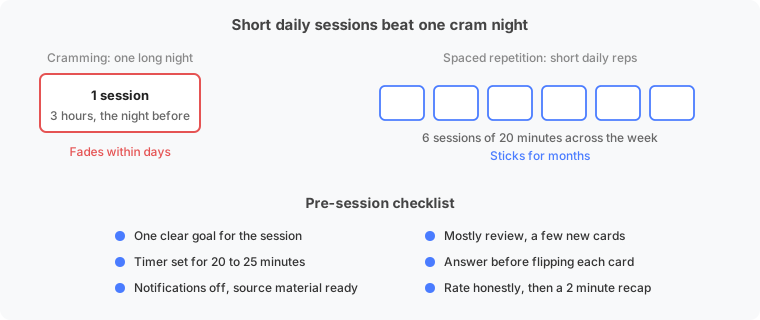
The trade is stark. A subject that takes 40 hours to cram, with a result that evaporates in a week, often takes only 15 to 20 hours when those hours are spread out, with a result that lasts for months. Twenty to thirty minutes of daily practice over a few weeks almost always beats one intense week. The aim here is not to shame anyone for cramming. It is to give you a smoother way to stop relying on it.
Cramming vs Spaced Repetition with Flashcards
| Approach | Typical hours | Retention after 2 weeks | Recall under exam pressure |
|---|---|---|---|
| Cramming the night before | ~40 hours in one push | Mostly gone | Fragile, fails on reworded questions |
| Short daily flashcard sessions | ~15 to 20 hours spread out | Largely intact | Flexible, holds up under pressure |
Your Pre-session Checklist
Smart sessions start before you open the deck. Thirty seconds of setup keeps you from drifting into passive rereading or burning out halfway through. Run through this checklist each time.
Pre-session Checklist
- Set one clear goal: a chapter, a card stack, or a target like "move every red card to yellow".
- Decide your mix of review versus new cards. Lean heavily on review, especially close to an exam, and keep new cards capped.
- Set a timer for 20 to 25 minutes of focus, with a short break after, instead of studying until you are exhausted.
- Prepare your environment: notifications off, source material within reach in case you need to fix or add a card.
- Commit to answering before you flip, ideally out loud or in writing, even when you are not sure.
- Reserve the last 2 to 3 minutes to note which cards need rewriting and which topics need a trip back to your notes.
How to Run a Smart Flashcard Session
Start the timer and begin with the cards that are due for review, not the newest ones. For each card, try to answer from memory before flipping. Say it out loud or write it down. The effort of retrieval is the entire point, so resist the urge to peek when a card feels hard.
After you flip, rate yourself honestly: easy, medium, hard, or forgotten. That rating is what feeds your schedule, whether you are sorting cards into Leitner boxes or letting an app handle the intervals. Optimistic self-rating is one of the most common ways people sabotage their own progress, because it pushes cards too far into the future before they are really learned.
Mix your topics within a session instead of grinding one subject for an hour. This is called interleaving, and the small jolt of switching context forces your brain to work harder to retrieve, which improves retention and your ability to tell similar ideas apart. Finish with a two-minute recap: which cards were hardest, and where do you have a genuine gap in understanding that no flashcard will fix until you revisit the source material.
Session Length Targets and Weekly Schedule
The single most useful rule is consistency over intensity. Ten to fifteen minutes a day across several weeks beats two hours once a week, every time. A focused block of 20 to 30 minutes with a short break is enough for a productive session, and most people lose accuracy if they push much past that without a pause.
The table below gives concrete targets depending on how far you are from your exam. Treat the daily numbers as floors you protect, not ceilings you have to hit. To turn cards due and time per card into a daily minute estimate, the daily review calculator does the arithmetic, and the exam study planner spreads a deck across the days you have left.
Session Length Targets by Timeline
| Situation | Daily session | Extra block | Focus |
|---|---|---|---|
| Maintenance, no exam soon | 10 to 20 min, 5 to 6 days a week | None needed | Keep due cards from piling up |
| 4 weeks out | 20 to 30 min daily | 1 weekly block of 45 min | Steady reviews, limited new cards |
| 8 to 12 weeks out | Start at 10 to 20 min, build to 30 | 1 to 2 blocks of 45 min | Build the deck, then shift to review |
| Exam week | 30 min of mixed review | Light 30 min the night before | Refine, do not add new material |
How to Stop Cramming with Flashcards
The way to study smarter with flashcards is to make the cram night unnecessary, and that is mostly a matter of timing. Start your deck early, ideally 8 to 12 weeks before an important test. Even 4 weeks of spaced practice beats a single crammed week, so it is rarely too late to switch.
Build your deck as you go. After each lecture or chapter, turn the key points into cards right away instead of waiting for the week before the exam. Block your sessions into your calendar as non-negotiable 15 to 30 minute slots tied to a specific deck, and lean on reminders so the review pile never gets a chance to snowball.
Keep new cards capped at 10 to 20 a day. Adding too many at once is the fastest way to drown in reviews later. Then turn exam week into a refinement phase: more mixed review, no new material, a light pass the night before, and a full night of sleep instead of an all-nighter. If you want a fuller plan, our guide on spaced repetition for exam prep walks through deck organization and a week-by-week schedule, and the Leitner system is a simple, low-tech way to manage the intervals by hand.
Common Flashcard Mistakes to Avoid
A few habits quietly cancel out the benefit of flashcards. Rereading a card without trying to answer first turns active recall back into passive review. Cards that are too long or too vague are hard to grade honestly, so split them into one idea per card. Dumping dozens of new cards in a single sitting creates a review avalanche days later.
Two more are subtle. Rating yourself too generously pushes cards too far into the future and breaks the schedule, so be honest when a card felt hard. And always studying cards in the same order means you start memorizing the sequence instead of the content, so shuffle your deck and interleave subjects. Fix these and your sessions get noticeably more effective without taking any longer.
Letting an App Handle the Scheduling
Everything above works on paper. The catch is the upkeep: deciding which cards are due, tracking intervals across subjects, and resisting the temptation to rate yourself kindly. An app that automates spaced repetition removes that friction so you can spend your session studying instead of managing logistics.
Betta is built around exactly this idea. You photograph your handwritten notes, printed slides, or a textbook page, and it turns them into a ready-to-review deck, which lowers the cost of building cards in the first place. The schedule adapts to how well you know each card, so difficult cards surface more often without you deciding when. You get streaks and stats to see your load at a glance, and short daily reminders that keep the review pile from snowballing into another cram night. The principles do not change. The app just takes care of the parts that make people quit.
FAQ: Studying Smarter with Flashcards
- How long should I study with flashcards each day?
- For most people, 15 to 30 minutes a day is the sweet spot. A focused 20-minute session done daily beats a two-hour session done once a week, because spreading reviews over time is what makes the information stick. If you have more time, take a short break and do a second block rather than pushing one session past the point where your attention drops.
- How many flashcards should I do per day?
- A practical target is 50 to 100 reviews plus 10 to 20 new cards per day, but the right number depends on the difficulty of your material and how much time you have. The key is to keep new cards limited so your review pile stays manageable. Adding 80 new cards in one sitting feels productive, but it creates an avalanche of reviews a few days later.
- Are digital flashcards better than paper?
- Paper cards are satisfying and work fine for small decks. Digital cards win on the things that are tedious by hand: they schedule each card for you, track your stats, and travel in your pocket. But the real lever is not the format. It is whether you are using active recall and spaced repetition. A well-used paper deck beats a neglected app every time.
- When should I start using spaced repetition before an exam?
- Ideally 8 to 12 weeks out, so the spacing effect has room to work. That said, you get a meaningful benefit from as little as 4 weeks of daily practice. Even a single week of short daily sessions beats the same number of hours crammed into one night. The earlier you start, the fewer hours you need overall.
- Can I still cram with flashcards the night before?
- A light 30-minute review the night before is fine and can help you warm up. What does not work is trying to build the memory from scratch in one sitting. Cramming gives you fragile, short-lived recall that often fails when a question is worded differently than your card. Use the night before for a gentle pass, then sleep.