
Forgetting Curve Calculator: When to Review
This forgetting curve calculator is a text tool, not a widget. It maps how many days have passed since your last review to an estimated retention percentage, then tells you when to review next so that recall does not slip below your target. Use it to answer the practical question behind most study planning: when should I review this so I do not forget it? The estimates come from the Ebbinghaus forgetting curve and modern spaced repetition research, and they are educational approximations, not guarantees about your own memory.
If you want the background story of why memories fade, read our guide on the forgetting curve first. This page is the actionable part. Feed it a number of days and a target retention, and it hands you a retention estimate plus a recommended review window. For the wider explainer on Ebbinghaus and the science, the guide at /guides/forgetting-curve goes deeper.
Key Takeaways
- A simple model of memory is R = e^(-t/S): retention R after t days, where S is the stability of the memory.
- Without review, retention drops fast at first then levels off. Roughly a third or less of unreviewed material survives a day, and a fifth or less survives a month.
- The plan is to review just before retention falls below your target, around 90 percent for most learners.
- Each successful review raises retention back toward 100 percent and increases stability, so the next interval can be longer.
- A practical interval sequence is 1, 7, 15, 30, and 90 days. The exact numbers matter less than reviewing before you forget.
- These retention percentages are educational estimates from population averages, not a measurement of your personal memory.
How This Forgetting Curve Calculator Works
The calculator rests on one idea: the longer you go without recalling something, the less of it you keep, and the drop is steep at first and gentle later. To estimate when to review, you need three things. First, the days since your last active review, meaning the last time you actually tested yourself rather than reread the page. Second, how many real reviews you have already done, because each one makes the memory more durable. Third, your target retention, the recall level you are willing to let a memory fall to before topping it up.
From those inputs the calculator does two jobs. It estimates roughly how much you still remember today, and it works out the day when your recall is about to drop below your target so you can review just before that point. The model assumes you did no sneaky reviews in between. If you have been quizzing yourself, your real retention is higher than the table shows.
The Forgetting Curve in 60 Seconds
Hermann Ebbinghaus described the forgetting curve in 1885 after testing himself on lists of nonsense syllables. He found that without review, memory drops sharply soon after learning and then forgets more slowly over time. Roughly half of fresh, meaningless material can be gone within a day or two, and only a fraction survives weeks later.
Two caveats matter. First, Ebbinghaus used nonsense syllables, which are forgotten faster than meaningful material you understand. If you truly grasp a topic, your personal curve is much flatter than these generic numbers. Second, these are historical averages, not laws. The point of a calculator is to give you an order of magnitude and a review window, not a precise reading of your brain.
The Forgetting Curve Formula in Plain Language
A widely used simple model is R = e^(-t/S). Here R is the probability you can recall the material, t is the number of days since your last review, and S is the stability of the memory, sometimes called the time constant. A bigger S means a flatter curve and slower forgetting. Stability grows every time you successfully review, and it is larger for easy or meaningful material than for hard or arbitrary content.
To decide when to review for a target retention R*, you rearrange the same formula: t = -S times the natural log of R*. For a target of 90 percent, the natural log of 0.9 is about -0.105, so the review day is roughly 0.105 times S. In plain words: we look for the moment your recall is about to slip below your target, for example 90 percent, and recommend a review just before that point. The calculator does not try to measure your personal S clinically. It uses reasonable defaults based on difficulty and how many reviews you have done.
This is the same logic behind modern algorithms like SM-2 and FSRS, which also model a recall probability that decays over time and trigger a review when it crosses a threshold. FSRS tracks three values, difficulty, stability, and retrievability, and uses a power-law curve to predict due dates more precisely than SM-2. Think of this calculator as a teaching version of that idea for a single topic, and an app like Betta as the full per-card version that targets around 90 percent recall automatically.
Days Since Last Review, Retention, and What to Do (Single Exposure)
| Time since learning | Estimated retention | What it means and what to do |
|---|---|---|
| 20 minutes | About 50 to 60 percent | You still hold most of it, but details are already fading. A quick recap locks them in. |
| 1 hour | About 40 to 50 percent | Almost half is gone. This is why same-day review is worth it. |
| 1 day | About 30 to 40 percent | Only a third or so remains. Review within 24 hours is the highest-value review you can do. |
| 1 week | About 20 to 30 percent | You are mostly guessing unless you reviewed in between. Relearn, do not just glance. |
| 1 month | About 20 percent or less | Expect fragments only, unless the material is highly meaningful. Treat it as near-new. |
When to Review With Spaced Repetition
The single-exposure table above is the worst case: one look, then nothing. The whole point of spaced repetition is to break that curve. Every time you successfully recall the material, retention jumps back toward 100 percent and stability rises, so the next safe gap is longer. After a few reviews the same topic that used to vanish in days can hold for weeks.
The table below interprets a days-since-last-review input when you have reviewed more than once. The retention bands are conceptual ranges, not exact readings, and they assume active recall rather than passive rereading. The action column is what to do if your target is around 90 percent.
Days Since Last Review With Spaced Repetition: Retention and Action
| Days since last review | Reviews done so far | Estimated retention | Recommended action |
|---|---|---|---|
| 0 to 1 day | 1 to 2 | 80 to 95 percent | You are safe. Schedule the next review in 2 to 4 days. |
| 3 to 4 days | 2 to 3 | 70 to 90 percent | Good time to review for high confidence, or wait a little longer if the topic is easy. |
| 6 to 7 days | 3 plus | 60 to 85 percent | Ideal window for the next review according to spacing research. |
| 14 to 21 days | 3 plus | 50 to 80 percent depending on difficulty | If this topic is exam-critical, review now before it slips further. |
| Over 30 days | any | Under 50 percent | Treat it almost like new material, especially for hard topics. Relearn, then space again. |
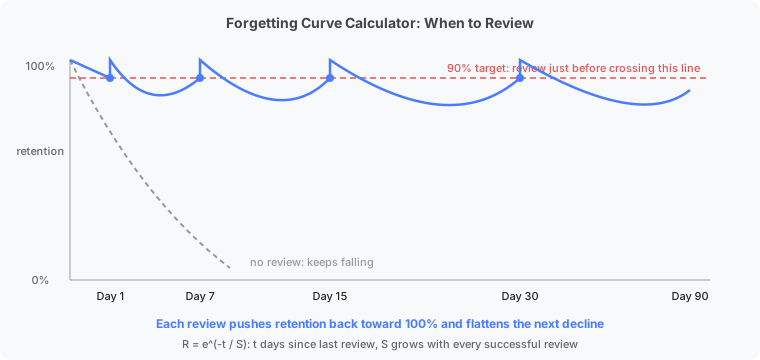
Example Review Schedule Inspired by the Forgetting Curve
| Review number | Days since first learning | Gap from previous review | Why this timing |
|---|---|---|---|
| 1st review | Day 1 | Plus 1 day | Retention has already fallen the most by now, so this review pays off the most. |
| 2nd review | Day 7 | Plus 6 days | Stability is higher after review 1, so a week is a safe gap. |
| 3rd review | Day 15 | Plus 8 days | Each success stretches the curve, so the next gap can grow. |
| 4th review | Day 30 | Plus 15 days | Approaching long-term memory. Monthly checks keep it warm. |
| 5th review | Day 90 | Plus 60 days | For well-learned material, quarterly review is often enough to maintain. |
Worked Example 1: A Chapter You Saw Yesterday
You studied a chapter once yesterday, so it is 1 day since your single review, difficulty is medium, and your target is 90 percent. With only one exposure, stability is still low, so the calculator estimates retention around 70 to 85 percent today. You are right at the edge of your target.
The recommendation is to review today or tomorrow to solidify the memory before it slides further, then follow the sequence: next review around day 6 to 7, then around day 15, then day 30. That first early review is the one that flattens your curve the most, so do not skip it.
Worked Example 2: A Hard Topic Left for 10 Days
You reviewed a topic three times, it is hard material, and you last touched it 10 days ago with a 90 percent target. Three reviews have built decent stability, but 10 days is a long gap for hard content, so the estimate lands around 60 to 80 percent. You are entering the risky zone.
If this is exam-relevant, review in the next 1 to 2 days. After that successful review, stability climbs again and you can stretch the next gap toward two or three weeks. If you keep letting hard topics drift past their window, they cost you a full relearn each time.
Worked Example 3: Vocabulary Reviewed Five Times, 30 Days Ago
You have language vocabulary you reviewed five times, the material is easy and familiar, you last reviewed 30 days ago, and your target is 85 percent. Five reviews on easy material build high stability, so even after a month the estimate stays relatively high, perhaps 60 to 80 percent.
The recommendation is a maintenance review within the week to keep mastery, then you can space the next one out to two or three months. This is the payoff of consistent spacing: the same 30-day gap that would wipe a hard, once-seen topic barely dents a well-practiced easy one.
Worked Example 4: Fitting Reviews Around an Exam Date
You last reviewed 3 days ago, you have done 2 reviews, and your exam is in 12 days. The calculator suggests one review today, around day 3 to 4, then another around day 9 to 10, just before the exam. That places a strong, recent review close to test day while keeping the earlier spacing that built your stability.
For a near deadline, lean toward a higher target retention and one extra review rather than fewer. The cost of an early review is small; the cost of forgetting on exam day is not. To turn this into a day-by-day plan across a whole deck, the spaced repetition calculator at /tools/spaced-repetition-calculator and the daily review calculator at /tools/daily-review-calculator both work from the same spacing idea.
How to Use This Tool Step by Step
Start by picking one specific topic, chapter, or small deck, not your whole syllabus. Estimates are far more meaningful for a focused unit than for everything at once. Then estimate your inputs: days since your last real recall session, how many reviews you have done, and how hard the material feels.
Read the retention estimate as a range with a short interpretation, for example we estimate you remember roughly 60 to 80 percent, so expect to recall the main ideas but forget some details if quizzed now. Then act on the recommended window: write a specific date in your planner or calendar inside that window rather than a vague someday. Finally, redo the estimate after each big review to watch the windows stretch as your stability grows.
A forgetting curve calculator is only useful if you actually do a solid, retrieval-based review when it tells you to. Rereading is not enough. If you would rather not compute curves for hundreds of cards, that is exactly what Betta automates: it schedules each card just before you are likely to forget it, targeting around 90 percent recall, and you can photograph notes or slides to build the deck in seconds.
Limits and Honest Caveats
- The percentages are educational estimates from population averages and a simple model, not a measurement of your memory.
- Meaningful material you understand is forgotten far more slowly than the nonsense syllables Ebbinghaus tested, so your real curve is usually flatter.
- Individual variation is large: sleep, stress, motivation, and the quality of your first study session all shift the curve.
- For high-stakes exams, aim for a safety margin with a higher target and an extra review rather than trusting one estimate.
- A full spaced repetition system like Betta or Anki adjusts every card continuously, while this tool gives one ballpark window for a topic.
How Spaced Repetition Breaks the Curve
The spacing effect is one of the most robust findings in learning research: reviews spread over time produce stronger long-term retention than the same study crammed into one sitting. Each successful, spaced recall slows your future forgetting, which is why the intervals in the schedule table can keep growing.
The reviews should be active. Testing yourself with flashcards or quizzes strengthens memory and lengthens stability far more than rereading, which mostly creates a false sense of familiarity. Algorithms like FSRS formalize this by aiming for a target recall probability, often around 90 percent, and rescheduling each card the moment its predicted recall is about to dip below that line. Betta does this work automatically, card by card, where this calculator gives you the big-picture intuition for a topic. For how spacing fits a full exam timeline, see /guides/spaced-repetition-exam-prep, and to compare box-based scheduling, the Leitner box calculator at /tools/leitner-calculator covers the classic 1/2/4/7/15 day version.
FAQ: Forgetting Curve Calculator
- Is a forgetting curve calculator accurate for everyone?
- No. The retention percentages are educational estimates built on historical averages and a simple decay model, not a measurement of your own memory. How fast you forget depends on how well you learned the material in the first place, how meaningful it is to you, sleep, stress, and how many times you have reviewed. Treat the numbers as a ballpark that tells you roughly when to review, not a guarantee.
- How often should I review according to the forgetting curve?
- A common pattern is to review within about 24 hours of first learning, then after roughly a week, then after a few weeks, then every one to three months. Each successful review flattens your curve and lets the next gap grow. Harder or exam-critical material deserves tighter spacing, while easy or familiar material can stretch further.
- What retention percentage should I aim for?
- Most modern spaced repetition algorithms target somewhere between 85 and 95 percent recall as a balance between study time and forgetting. A target of 90 percent is a sensible default for most students. A higher target like 95 percent means more frequent reviews, while 80 percent saves time at the cost of forgetting a bit more.
- What is the difference between a forgetting curve calculator and a spaced repetition app?
- This calculator gives you a one-off estimate and a review window for a single topic or small set of cards. A spaced repetition app like Betta tracks every card individually, adjusts to whether you got each one right or wrong, and reschedules each review automatically just before you are likely to forget. The calculator builds intuition; the app does the per-card bookkeeping for you.
- Can I use this calculator to plan my entire exam prep?
- It is useful for understanding your forgetting risk and roughly timing reviews, but it is not a full study plan on its own. For an exam, combine a calculator estimate with an overall study calendar, an app to handle the details of every card, and practice tests. Do not schedule months of preparation from a single curve.
- What if I have not reviewed something for months?
- Treat it almost like new material, especially if it is hard. Do a dense first exposure to relearn it, then apply a tighter spacing sequence again such as day 1, day 3 to 4, then a week, then a few weeks. Relearning is usually faster than the first time, but you should not assume the old memory is still there.
- Does sleep or time of day affect my forgetting curve?
- Sleep helps. Some research suggests that reviewing close to sleep can support memory consolidation and slow forgetting. Time of day matters far less than consistency though. Regular, spaced, active reviews beat trying to find a perfect hour to study.