
Spaced Repetition
The Forgetting Curve
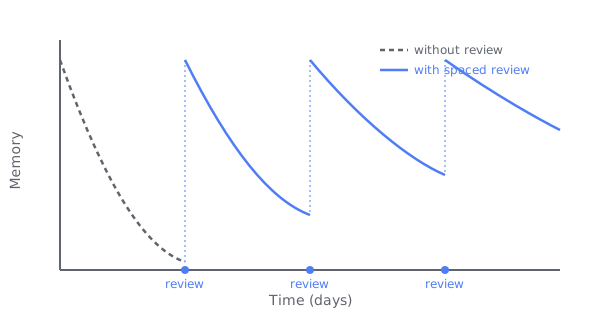
In the late 19th century, psychologist Hermann Ebbinghaus discovered something obvious but profound: we forget things exponentially fast. Within a few days of learning something new, you will forget the vast majority of it unless you review it.
This exponential loss is called the forgetting curve.
How Spaced Repetition Works
Spaced repetition flattens the forgetting curve. Instead of cramming all your study time into one night, you space your reviews out over increasing intervals.
Every time you review a flashcard, your memory of it becomes stronger, and the time it takes to forget it gets longer. The trick is to review the card right when you are about to forget it. Not too soon, and not too late.
The Leitner System
The Leitner system is a practical way to apply spaced repetition. Flashcards are sorted into boxes based on how well you know them.
When you get a card right, it moves to the next box and the review interval increases (for example: 1 day, then 2 days, then 4 days, 7 days, and 15 days). When you get it wrong, it goes back to the first box.
Betta uses the Leitner system under the hood, but handles all the scheduling for you.
Spaced Repetition vs Cramming
| Approach | Time Spent | Retention After 1 Week | Stress Level |
|---|---|---|---|
| Cramming | 4 hours the night before | Very Low | High |
| Spaced Repetition | 20 minutes a day | Very High | Low |
Frequently Asked Questions
- Does spaced repetition work for everything?
- It is best for memorizing discrete facts: vocabulary, dates, formulas, and definitions. It is a tool for retention, not necessarily for initial comprehension.
- How long should I study each day?
- Shorter sessions are better. A focused 15 to 20 minute session every day will yield much better results than a two hour session once a week.