
How to Use Spaced Repetition for Exam Prep
The night before an exam, most students reread their notes for hours. It feels productive. It rarely works. Research consistently shows spaced repetition produces far stronger long-term retention than cramming while requiring less total study time.
Key Takeaways
- Spaced repetition spreads reviews across days and weeks so each session catches memories just before they fade.
- The forgetting curve and the testing effect explain why this method outperforms rereading and cramming every time.
- A 6-week exam schedule means lighter daily sessions at the start and strong recall by the final week.
- Effective flashcards are short, in question-and-answer format, with one idea per card.
- Betta turns a photo of your notes into ready-to-review flashcards, with review sessions scheduled automatically around your exam date.
What Is Spaced Repetition?
Spaced repetition is a study method where you review the same material at increasing intervals over time, rather than all at once. Instead of reading a chapter once and hoping it sticks, you study it, review it the next day, then three days later, then a week later, then two weeks later. Each review is timed to happen just before the memory fades.
This is the opposite of massed practice, which is the technical term for cramming. When you cram, you stuff information in right before a test. You might pass, but most of that material disappears within days because it never made it into long-term memory.
Spaced repetition works for anything with facts, definitions, formulas, vocabulary, or concepts you need to recall from memory. That covers most of what students are tested on.
Why Spaced Repetition Works So Well for Exams
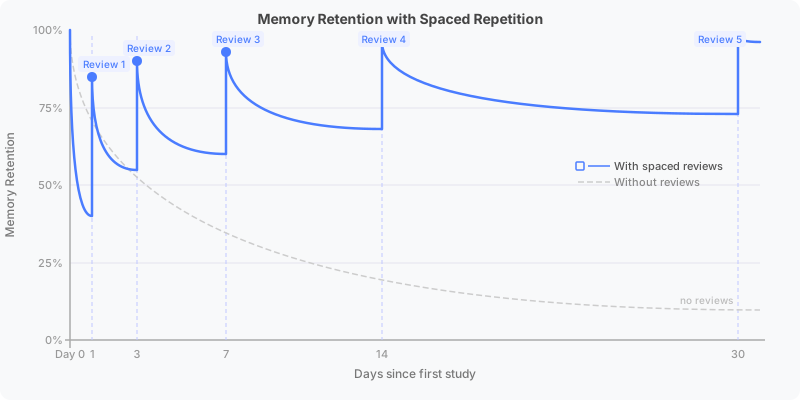
In the 1880s, Hermann Ebbinghaus plotted how quickly people forget newly learned information. The forgetting curve drops steeply in the first 24 hours, then more gradually after that. Every time you review material, the curve resets at a higher baseline, so you forget more slowly the next time. After several spaced reviews, the knowledge becomes durable.
The second mechanism is the testing effect, also called retrieval practice. When you try to recall something from memory, the act of retrieving it strengthens the memory more than rereading does. This is why flashcards beat highlighting. Struggling to remember an answer, even for a few seconds, builds stronger neural pathways than passively reading the same information.
These two effects explain why students who study in spaced sessions consistently outperform students who cram, even when the cramming students spend more total hours studying.
Step-by-Step: How to Use Spaced Repetition for Exam Prep
1. Note your exam dates and count backward. If your exam is six weeks away, you have enough time for a full schedule. If it is two weeks away, you can compress the intervals and still get meaningful benefit.
2. Break your syllabus into small topics. Group the material by chapter, theme, or concept cluster. Each topic becomes a deck of flashcards. Aim for 10 to 30 cards per topic so sessions stay manageable.
3. Turn each topic into flashcards. Use a clear question on the front and a short answer on the back. One idea per card. If you use Betta, you can photograph your notes and the app generates the cards automatically.
4. Assign each new deck a spacing sequence. A simple and reliable sequence is Day 0 (learn), Day 1, Day 3, Day 7, Day 14, Day 30. Set those review dates in your calendar or let your app schedule them for you.
5. During every review session, work through active recall only. Cover the answer, read the question, try to answer from memory, then check. Do not reread. Do not skip cards that feel hard. Rate each card honestly so difficult cards come back sooner.
Sample 6-Week Spaced Repetition Schedule
| Week | Focus | Daily session |
|---|---|---|
| Weeks 5 to 6 | First exposure: read actively, take notes, create flashcards | 30 to 40 min |
| Weeks 3 to 4 | First reviews (Day 1 and Day 3 intervals), add practice questions | 30 to 45 min |
| Weeks 1 to 2 | Longer reviews (Day 7 and Day 14 intervals), mix in past papers | 40 to 60 min |
| Final week | Review difficult cards, full past-paper sessions, light daily review | 45 to 60 min |
Spaced Repetition Review Intervals
| Review | Days since learning | Purpose |
|---|---|---|
| 1st review | Day 1 | Catch the steepest part of the forgetting curve |
| 2nd review | Day 3 | Consolidate short-term memory |
| 3rd review | Day 7 | Build long-term retention |
| 4th review | Day 14 | Confirm the memory is durable |
| 5th review | Day 30 | Near-permanent retention before exam day |
How to Make Effective Flashcards for Exams
A flashcard only works if it forces you to retrieve the answer from memory. The question must be specific enough to have one clear answer, and the answer must be short enough to say in a sentence or two.
The most reliable format is a direct question on the front and a brief answer on the back. For example, front: "What triggers the release of insulin?" Back: "A rise in blood glucose following a meal." Avoid vague questions like "Tell me about insulin." You will never know if your answer was right or wrong.
Vary the card types to match the exam. For factual subjects like anatomy, history, or law, use definition and list cards. For conceptual subjects like math or physics, add cards for worked examples and important formulas. For languages, vocabulary and sentence-structure cards work particularly well.
Betta generates a full deck automatically from a photo of your notes or textbook page. This cuts preparation time so you get to reviewing sooner. See our guide on how to make flashcards from your notes for more advice.
Practical Methods: Leitner System, Apps, and Betta
The Leitner system is the classic physical version of spaced repetition. You sort flashcards into five boxes, each reviewed at a different frequency. A card you answer correctly moves to the next box, which has a longer interval. A card you get wrong goes back to box one. The system is simple enough to run with paper cards and a set of dividers.
For digital studying, Anki, Quizlet, and RemNote all automate interval scheduling. Anki uses a sophisticated algorithm that adjusts intervals based on how difficult each card felt. The drawback for most students is setup time. Creating a full deck for a medical or law exam can take days of manual typing before you review a single card.
Betta is built for students who study from physical notes, printed slides, or textbook pages. You photograph the material and the app generates the flashcards. The spaced repetition schedule is then aligned to your exam date, so you do not have to manage intervals yourself. The focus is on reviewing, not on building the deck.
Leitner Box Intervals for Exam Prep
| Box | Review frequency | Represents |
|---|---|---|
| Box 1 | Every day | New or recently failed cards |
| Box 2 | Every 2 days | Cards learned once |
| Box 3 | Every 4 days | Cards with some familiarity |
| Box 4 | Every 7 days | Well-learned cards |
| Box 5 | Every 15 days | Mastered cards |
Common Mistakes Students Make with Spaced Repetition
Starting too late is the most common mistake. Spaced repetition requires multiple review sessions spread over weeks. If you start four days before the exam, you can only fit two or three sessions per card, which is not enough to build durable memory. Start at least three to four weeks before any major exam.
Making cards too long defeats the purpose. If a card has three sentences on the back, you will never know which part you actually remembered. Break long answers into two or three shorter cards.
Passive review kills the testing effect. Looking at the question and then immediately flipping to check the answer is just rereading with extra steps. Always try to recall the answer first, even if it takes ten or fifteen seconds of genuine effort.
Skipping sessions breaks the spacing sequence. If you miss a scheduled review, catch up the next day rather than waiting until your next planned session. A slightly compressed interval is far better than a gap of several days.
Reviewing only easy cards is a subtle trap. The cards that feel effortless to answer are the ones that need the least attention. Prioritize the ones you keep getting wrong.
Combining Spaced Repetition with Other Study Techniques
Pomodoro sessions pair well with flashcard review. A focused 25 to 30-minute block for active recall, followed by a five-minute break, keeps concentration sharp and prevents review fatigue.
Interleaved practice means mixing different subjects or card types in a single session rather than blocking all the biology cards together, then all the chemistry cards. Switching between topics forces your brain to retrieve the right retrieval cue, not just the answer, which produces more durable learning.
Sleep plays a direct role in memory consolidation. When you spread your study sessions across days, you get multiple sleep cycles between reviews. Deep sleep consolidates what you practiced during the day, which is one reason spaced sessions leave a stronger trace than an overnight cram.
Brain dumps can supplement your flashcard sessions. Before reviewing, write down everything you can remember about a topic from scratch, then compare it to your cards. This extra retrieval effort shows you exactly which concepts are still shaky.
FAQ: Spaced Repetition for Exam Prep
- Is spaced repetition good for exam preparation?
- Yes. Research consistently shows spaced repetition produces significantly higher long-term retention than cramming. It works especially well for exams that test factual recall, including medical boards, standardized tests, law exams, and language proficiency tests.
- When should I start using spaced repetition before an exam?
- Start at least four to six weeks before the exam if you can. The method requires multiple review sessions spread over time, so the earlier you begin, the more sessions you fit in before exam day. Even starting two weeks out gives a meaningful advantage over cramming the night before.
- What is the best spaced repetition schedule for exams?
- A reliable starting sequence is Day 0 (first learning), Day 1, Day 3, Day 7, Day 14, and Day 30. Apps like Betta and Anki calculate these intervals automatically. For shorter timelines, compress to Day 0, Day 1, Day 3, Day 7.
- How do I use spaced repetition if my exam is in 2 weeks?
- With two weeks left, use a compressed schedule: learn the material, then review on Day 1, Day 3, Day 7, and again two to three days before the exam. Prioritize the topics most likely to appear and use active recall rather than rereading. Spaced sessions over two weeks still outperform a single cram night.
- How many flashcards should I review per day for exam prep?
- For most students, 50 to 100 cards per day is a manageable and effective target. If you have a large deck, front-load new cards earlier in your schedule so you are mostly reviewing, not learning, in the final week before the exam.
- Can I use spaced repetition for essay-based exams?
- Yes, with some adaptation. Use flashcards for main arguments, quotes, case studies, dates, and definitions. Practice short-answer versions of essay prompts as a recall exercise. You will still need to write full essays for practice, but spaced repetition handles the building blocks.
- How is spaced repetition different from cramming?
- Cramming concentrates all study into one or two sessions close to the exam. You may retain the information for a few hours, but most of it fades within days. Spaced repetition distributes review sessions over weeks, each one reinforcing the memory at the right moment. The result is knowledge that stays with you after the exam.
- Do I still need to do practice papers if I use spaced repetition?
- Yes. Spaced repetition builds your knowledge base. Practice papers train you to apply that knowledge under time pressure, in the format the exam uses. The two methods are complementary. A good exam schedule includes regular flashcard sessions early on, with practice papers added in the final two to three weeks.
How Betta Makes Spaced Repetition Effortless for Exam Prep
The hardest part of spaced repetition for most students is not the reviewing. It is the setup. Creating a full deck of flashcards from a semester of notes takes hours of typing that most students do not have.
Betta removes that barrier. You photograph your notes, slides, or textbook pages and the app generates the flashcards automatically. You go from a photo to a reviewable deck in seconds.
Once your cards are in the app, Betta schedules your review sessions around your exam date. You tell it when the exam is and how much time you have each day. It handles the interval calculation so you do not have to manage a spreadsheet of due dates.
Each session uses active recall only. You see the question, answer from memory, and rate how well you remembered. Cards you found difficult come back sooner. Cards you know well get pushed further out. By the time exam day arrives, you have reviewed every card the right number of times.