
What Is the Leitner System?
The Leitner system is one of the most practical study methods ever devised. You sort flashcards into boxes based on how well you know them, review difficult cards often and easy ones rarely, and let the system tell you what to study each day. It sounds almost too simple, but it works because it is built on the same science behind every modern spaced repetition algorithm.
Key Takeaways
- The Leitner system sorts flashcards into 5 boxes, each reviewed at a different frequency: daily for Box 1, every 15 days for Box 5.
- A correct answer promotes a card to the next box. A wrong answer sends it back to Box 1.
- The method implements two well-documented memory principles: the spacing effect and retrieval practice.
- Sebastian Leitner developed the system in the early 1970s as a simple, paper-based way to apply memory science.
- Paper boxes work well for small decks. For larger volumes, apps like Betta automate the same principles with per-card scheduling.
What Is the Leitner System?
The Leitner system is a spaced repetition technique that organizes flashcards into a series of boxes, each reviewed at a different interval. Cards you recall correctly advance to the next box, which has a longer gap before the next review. Cards you get wrong go back to the first box, where you will see them again the next day.
Sebastian Leitner, a German science journalist, developed the method in the early 1970s. He wanted a practical way to apply what was then emerging research on memory and forgetting to everyday study. His insight was to use physical boxes as a simple scheduling mechanism. No software required, no calendar to maintain. The box a card sits in tells you exactly when to review it next.
The method became popular among language learners and students studying structured facts. It remains one of the clearest introductions to spaced repetition because the logic is visible: you can watch your cards move through the boxes as you learn.
How the Leitner System Works
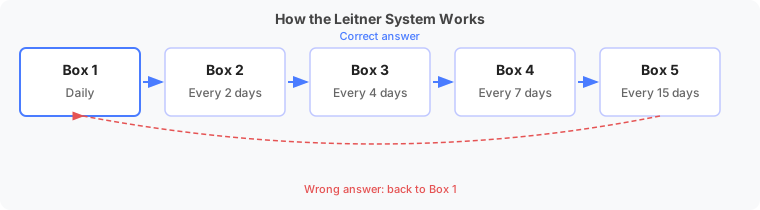
Picture five boxes lined up on your desk, numbered 1 through 5. Every new card starts in Box 1 and gets reviewed every day. When you answer a card correctly, it moves to the next box. Box 2 comes up every two days. Box 3 every four days. Box 4 every week. Box 5 every fifteen days or so.
When you get a card wrong, it returns to Box 1, no matter which box it was in. This is the key rule: a wrong answer resets the clock entirely. The card joins the daily pile until you answer it correctly several times in a row and it makes its way back through the boxes.
Over a few weeks, a clear pattern emerges. Box 1 holds your hardest and newest cards. Box 5 holds facts you have learned thoroughly enough to only need occasional review. You spend most of your time on what you do not know yet, and almost no time on what you have already mastered.
Leitner System Intervals
| Box | Review every | What it holds |
|---|---|---|
| Box 1 | Every day | New cards and recently missed cards |
| Box 2 | Every 2 days | Cards answered correctly once |
| Box 3 | Every 4 days | Cards with growing familiarity |
| Box 4 | Every 7 days | Well-learned cards |
| Box 5 | Every 15 days | Cards approaching full mastery |
Leitner System Variants
- 3-box version: "Don't know / Kind of know / Know well", reviewed daily, every few days, and weekly. Good for beginners or tight timelines.
- 5-box version: the classic setup, with intervals roughly doubling between each box. Used in most guides and apps.
- 7-box version: extends the mastered tier to intervals of several months. Useful for long-term retention of large vocabulary sets.
- Easy / Medium / Hard: replaces numbered boxes with difficulty categories reviewed at different weekly frequencies. Suits learners who prefer labels over numbers.
- Gentle demotion variant: a wrong answer drops a card one box back instead of all the way to Box 1. Less punishing for large decks.
How to Set Up Paper Leitner Boxes
You need five containers: index card boxes, labeled envelopes, or tabbed dividers inside a single box. And a stack of blank index cards. Label them Box 1 through Box 5.
Write one question on the front of each card and the answer on the back. One idea per card. If an answer needs more than two sentences, split it into two cards.
Set a daily review time. Each session starts with Box 1, which you review every day without exception. Then check which other boxes are due that day based on your interval schedule. A practical approach is to note the date when a card is promoted, then count forward to find when it next comes due.
Add no more than 10 to 20 new cards per day. If you add too many at once, Box 1 quickly becomes unmanageable. A steady daily intake, kept up over weeks, builds a robust deck without overwhelming your sessions.
Leitner System vs Other Study Methods
| Method | How it works | Long-term retention | Best for |
|---|---|---|---|
| Cramming | All study in one session near the exam | Fades within days | Short-term, single attempt |
| Re-reading | Passive re-exposure to notes | Weak (familiarity is not recall) | Orientation, not memorization |
| Leitner system | Fixed box intervals, manual sorting | Strong for small decks | Paper study, structured facts |
| SRS algorithm (Anki, Betta) | Per-card intervals tuned to your responses | Strongest, scales to thousands of cards | Large decks, long-term retention |
Limits of the Paper System
The Leitner system has one structural limitation: every card in a box shares the same interval, regardless of how difficult that individual card is. Box 3 might hold a date you nearly always recall and a formula you barely know. Both wait four days. Modern spaced repetition algorithms track each card independently and adjust its next review based on how hard it felt each time.
Physical boxes also require manual maintenance. You sort cards, track which boxes are due each day, and handle the logistics yourself. Miss a day and the due cards pile up. Start a second subject and you need a second set of boxes.
For small decks, a few hundred vocabulary words or the material for a single exam, the paper method works well. For anything larger, the overhead grows fast. This is why most learners start with paper Leitner boxes and eventually switch to an app. The principles stay the same; the friction disappears. For more on how spaced repetition scales to exam prep, see our guide on how to use spaced repetition for exam prep.
Using the Leitner System in an App
Several apps implement the Leitner box model directly, with virtual boxes you can see and move cards between. Others, including Betta, use the same core principle, showing difficult cards more often and spacing out easy ones, but apply a more precise algorithm that adjusts each card's interval individually based on your performance history.
The practical advantage is significant. No sorting, no date tracking, no separate boxes for separate subjects. You review cards on your phone, rate each one, and the app handles the rest. You also get statistics: how many cards are in each stage, which topics need more work, how your retention is trending.
If you want to calculate your next review date under the classic 5-box schedule, the Leitner box calculator gives you the exact day for any box and start date.
Betta works particularly well if you study from handwritten notes, printed slides, or textbook pages. You photograph the material and the app turns it into a ready-to-review deck. The spaced repetition schedule adapts to how well you know each card, so difficult cards surface more often without you having to decide. The Leitner system's core idea, more time on what you do not know and less on what you do, is still there. The boxes are just invisible.
FAQ: The Leitner System
- Who invented the Leitner System?
- Sebastian Leitner, a German science journalist, developed the system in the early 1970s. He published the method in his 1972 book "So lernt man lernen" (How to Learn to Learn) as a practical, paper-based way to apply memory research to everyday study.
- How many boxes do you need for the Leitner System?
- Most versions use 3 to 5 boxes. Five is the most widely recommended because it creates enough tiers to space out well-learned cards meaningfully. If you are just starting out, three boxes reviewed daily, every few days, and weekly is simpler and still effective. Some learners extend to 7 boxes for very long-term retention.
- What are typical Leitner System intervals?
- The classic 5-box schedule uses: Box 1 every day, Box 2 every 2 days, Box 3 every 4 days, Box 4 every 7 days, Box 5 every 15 days. These roughly double at each step. You can adapt them, for example 1, 3, 7, 14, and 30 days, as long as intervals increase progressively.
- Is the Leitner System effective?
- Yes. The method works because it applies two well-documented memory principles: the spacing effect (reviews spread over time produce stronger retention than massed study) and retrieval practice (actively recalling an answer strengthens memory more than rereading). It is a practical, low-tech implementation of spaced repetition that works well for small to medium decks.
- Is the Leitner System outdated?
- Not for paper-based study or small decks. For large volumes of cards (several hundred or more), modern spaced repetition algorithms like FSRS track each card individually and are more efficient. The Leitner system remains a solid introduction to spaced repetition and a good option if you prefer physical flashcards.
- Can I use the Leitner System in an app?
- Yes. Several apps replicate the box model with a digital interface. Others, including Betta, use the same core principle, showing difficult cards more often and spacing out easy ones, with a more precise per-card algorithm. The result is the same experience with less manual work.